

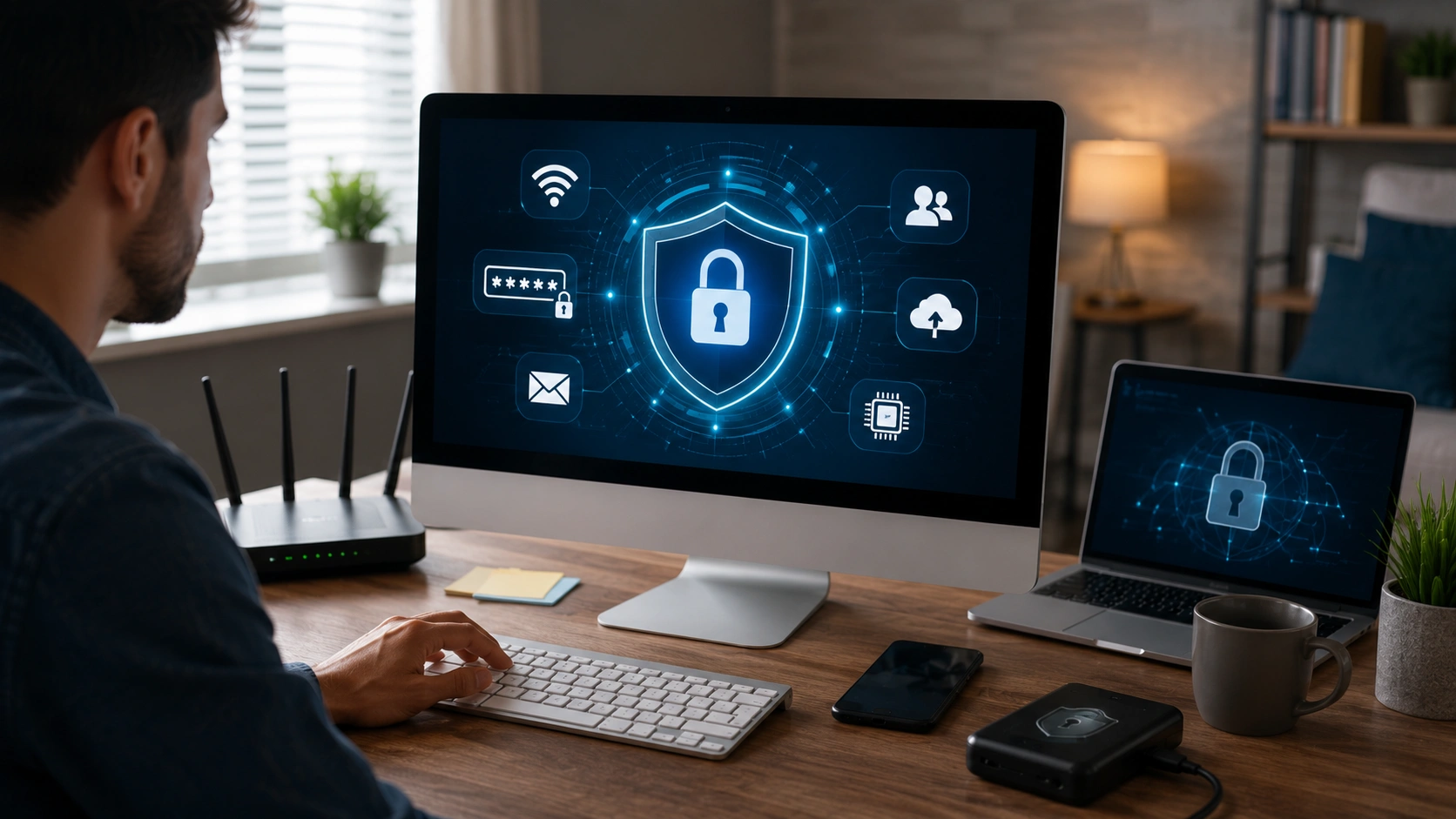
How can you protect your home computer cyber awareness 2026 is no longer just about installing antivirus and hoping for the best. In 2026, protecting a home computer means building a layered defense against phishing emails, ransomware, password theft, deepfake scams, unsafe websites, public Wi-Fi risks, and weak home Wi-Fi security. A modern home computer security plan should cover your device, your accounts, your home router, your backups, and the people who use the system every day.
The good news is that you do not need to be a cybersecurity expert to stay safer online. Most successful attacks still happen because of simple mistakes: weak passwords, reused passwords, unpatched software, suspicious links, fake software updates, and poor backup habits. If you focus on digital hygiene, strong passwords, MFA, WPA3, safe browsing, and the 3-2-1 rule, you can dramatically reduce your risk. This guide explains the biggest online threats, the best ways to protect your home computer, and the practical steps that matter most for families, students, and remote workers in 2026.
Why Home Computer Cyber Awareness Matters More in 2026
A lot of people still assume that hackers, cybercriminals, and attackers mainly go after large companies. That is not true anymore. Home users are attractive targets because they often have valuable personal data, saved passwords, banking accounts, tax files, school accounts, work logins, and cloud storage, but weaker protections than businesses.
In 2026, the threat landscape is broader and more deceptive. Traditional malware, spyware, trojans, and worms are still around, but now users also face polished phishing scams, deepfakes, fake login pages, OTP scams, KYC alerts, courier tracking scams, and social engineering through social media DMs and messaging apps. Many users also rely on connected devices like smart TVs, phones, printers, and smart home gadgets, which adds more points of exposure inside the home network.
That is why cyber awareness matters. It helps you notice suspicious behavior before it turns into identity theft, account takeover, or ransomware on computers and cloud. The best protection strategy in 2026 is not one magic tool. It is a system of safe habits, timely updates, stronger login security, backups, and smarter decisions.
The Most Common Threats to a Home Computer
The first major threat is phishing. This includes phishing emails, fake delivery notices, fake bank messages, and malicious login prompts that try to steal your password or trick you into downloading malicious software. Today’s phishing attacks often look professional, which is why people still click suspicious links and attachments even when they know better.
The second major risk is malware. This broad category includes spyware, trojans, worms, adware, and ransomware. Some malware quietly watches what you do. Some steals browser data or saved passwords. Some locks your files and demands payment. Ransomware is especially dangerous because it can hit both local files and cloud accounts if synced folders are affected.
A third threat is password theft. Weak passwords, reused passwords, and poor recovery settings make account takeover far easier. Attackers also use credential stuffing, where stolen username-and-password combinations are tested across many services. This is one reason password reuse is so risky.
Then there is network exposure. Unsecured networks, weak router settings, outdated router firmware, default credentials, and unsafe public Wi-Fi can expose traffic or open the door to further attacks. A badly configured Wi-Fi router can become the weakest part of your home computer cybersecurity plan.
Finally, scams are evolving. Deepfake tricks and scams, quishing or QR code phishing, smishing, vishing, and tech support scams target emotion and urgency rather than technical weakness. That is why awareness is just as important as software.
12 Best Ways to Protect Your Home Computer in 2026
The best approach is layered protection. Each step strengthens a different part of your digital life.
-
Turn on automatic updates everywhere
One of the easiest ways to protect your home computer from cyber threats is to keep everything updated. That means your Windows, macOS, browser, apps, plugins, and home router. Automatic updates reduce the time your system stays exposed to known weaknesses. Good patch management is boring, but it works.
-
Use reputable antivirus and anti-malware protection
A quality antivirus software or anti-malware tool still matters. It can catch known threats, flag unsafe downloads, and provide real-time protection against suspicious behavior. Built-in tools are often better than people assume, but the key is to keep them active and current.
-
Enable your firewall
A firewall helps block unwanted network traffic and adds an extra layer between your device and outside threats. On many systems, Windows Defender Firewall or macOS Firewall is already available. Do not disable it unless you have a very specific reason.
-
Create strong, unique passwords
Strong passwords remain essential. Every major account should have its own unique password, especially your email, banking, and cloud storage accounts. A reused password can turn one small breach into multiple compromised accounts.
-
Use a password manager
A password manager solves the biggest problem people have with passwords: remembering them. Tools like 1Password, LastPass, and Dashlane help you create and store long, unique credentials. This is one of the smartest ways to reduce weak passwords and reused passwords.
-
Turn on MFA or 2FA
Multi-factor authentication, MFA, two-factor authentication, and 2FA make stolen passwords much less useful. Turn it on for your email, financial accounts, cloud services, and any account that can reset other passwords. An authentication app is usually safer than text-message codes when possible.
-
Use passkeys where available
This is one area where many competitor articles were weak. Passkeys, passwordless sign-in, and phishing-resistant authentication are increasingly important in 2026. They reduce the risk of fake login pages because there is no traditional password to steal in the same way. When an important account supports passkeys, enabling them is often smarter than relying only on old password habits.
-
Secure your home Wi-Fi router
Your home router protects every connected device. Change default admin credentials, update router firmware, use WPA3 encryption if available, and create a guest network for visitors or less-trusted IoT devices. This helps reduce unauthorized access and improves home Wi-Fi security.
-
Back up your files using the 3-2-1 rule
The 3-2-1 rule is simple: keep 3 copies of data, on 2 types of media, with 1 stored off-site. That could mean your computer, an external hard drive, and cloud backups. This is one of the best defenses against ransomware, hardware failure, and accidental deletion.
-
Avoid suspicious links, downloads, pop-ups, and attachments
Many attacks still begin with a click. Be cautious with unexpected attachments, pop-ups that push fake cleanup tools, and login links sent through email or text. Download software only from official sources, and avoid random browser prompts that claim your device is infected.
-
Protect smart devices and shared family devices
A secure shared family computer needs clear rules. Every user should have a separate profile or account. Children should not install random software. Smart devices and smart home gadgets should go on a separate guest Wi-Fi when possible.
-
Use safe browsing habits and limit data exposure
Strong safe browsing habits matter every day. Check URLs carefully, use privacy settings, avoid oversharing on public platforms, and review browser security settings and browser extension security. Remove unused software, review sharing permissions, and follow the principle of least privilege. The less unnecessary access you give away, the safer you are.
How to Secure Your Home Wi-Fi and Router?
A lot of people focus only on the laptop and forget the network around it. But if your router admin panel security is weak, your whole setup is weaker. Start by changing the default admin username and password. Attackers know common defaults, and some automated tools actively test them.
Next, check for firmware updates for routers. This matters whether you use a TP-Link Archer AX55, ASUS RT-AX86U, Netgear Nighthawk AX5400, or another model. Outdated firmware can leave you open to known vulnerabilities.
Then switch to WPA3 if your router supports it. If not, use strong WPA2 settings rather than leaving security weak or open. Creating a guest network is also smart. It separates less-trusted devices from the main network and supports basic network segmentation at home.
You should also review DNS and management settings. Secure DNS, turning off remote management if unnecessary, and protecting against DNS hijacking can make your home network much harder to abuse.
Passwords, MFA, and Passkeys: Which Login Protection Matters Most?
The best answer is not one or the other. It is layered login protection.
Start with strong passwords stored in a password manager. Add MFA or 2FA to your most important accounts. This alone blocks a huge amount of casual account abuse. But in 2026, you should also understand passkeys vs passwords.
A password can be stolen through phishing, malware, or reuse across multiple sites. A passkey is designed to be more resistant to those problems. It ties sign-in to a trusted device or biometric flow instead of a password you type into a page. That makes it a strong option for reducing credential stuffing and account takeover risk.
For high-value accounts like your email, primary cloud account, or financial services, the smartest move is often: unique password, phishing-resistant MFA, and passkeys when supported. That is far stronger than relying on one simple password alone.
How to Spot Phishing, Deepfakes, and Social Engineering Scams?
Modern scams are built to feel urgent and believable. A message may claim there is a problem with your bank, package delivery, tax account, or login attempt. It may include fake banking alerts, courier tracking links, or warnings about your account being locked.
Look for pressure, urgency, and requests for immediate action. Be suspicious of poor domain names, strange sender addresses, unexpected attachments, and QR codes that ask you to log in. Quishing, or QR code phishing, is growing because it shifts the scam to your phone and makes you less likely to inspect the link first.
You should also watch for deepfake scams, fake voice calls, and vishing attempts that sound official. The same goes for smishing, where scam texts push urgent links or one-time codes. A good rule is simple: do not trust a message just because it looks polished. Open the official website yourself instead of clicking the link.
Backups, Recovery, and What to Do After a Cyber Incident
A smart article about home computer cyber awareness should not stop at prevention. You also need a recovery plan.
Backups are your safety net. Following the 3-2-1 backup rule means you can often recover from ransomware, accidental deletion, or device failure without disaster. Keep offline copies or an external hard drive in addition to cloud storage so one incident does not wipe out everything at once.
If you click a suspicious link, act fast. Disconnect from the network if something immediately seems wrong. Change passwords for sensitive accounts starting with your email. Review new device login alerts, revoke suspicious sessions, and run security scans. If you entered your credentials, update them right away and strengthen the account with MFA or a passkey.
If the device seems infected, avoid logging into banking accounts or other sensitive services until you are sure it is clean. This is where an incident response checklist for home users helps: disconnect, scan, change passwords, review recovery methods, restore from backup if needed, and monitor for fraud attempts.
Cyber Safety Tips for Families, Shared Computers, and Remote Workers
A household often has mixed habits, mixed skill levels, and mixed devices. That is why family cyber hygiene matters. One person’s risky behavior can affect everyone else on the network.
For families, start with separate user accounts, shared rules about downloads, and clear warnings about fake antivirus, suspicious links, and social media scams. Teach children and older family members how to question urgent messages, especially those involving OTP, deliveries, or money requests.
For remote workers, keep personal and work data separate. Be careful with Zoom, file sharing, and screen-sharing tools. Review sharing permissions, avoid using weak public Wi-Fi, and never store work credentials carelessly on a shared machine. A little structure goes a long way when multiple people use the same system.
Mistakes That Make a Home Computer Easy to Hack
Most successful attacks come down to preventable mistakes. The biggest one is ignoring updates. Another is using the same password for several accounts. Others include installing random browser extensions, clicking fake software update prompts, downloading pirated or unofficial programs, and leaving the router on default settings.
People also underestimate account recovery email security. If your main email is compromised, many other accounts can fall with it. That is why you should protect your email account first and secure your password reset methods.
Another common mistake is keeping too much unused software on a device. Old apps, forgotten tools, and risky extensions increase exposure. Remove unused software, review what has permission to run, and keep your setup clean.
Home Computer Security Checklist for 2026?
Here is a quick home computer security checklist you can actually follow:
| Security area | What to do |
|---|---|
| Updates | Turn on automatic updates for OS, browser, apps, and router |
| Passwords | Use strong passwords and a password manager |
| Login protection | Enable MFA / 2FA and use passkeys where possible |
| Network | Secure your router, use WPA3, and create a guest network |
| Backups | Follow the 3-2-1 rule with cloud and offline copies |
| Browsing | Avoid suspicious links, fake pop-ups, and unknown downloads |
| Privacy | Review permissions, privacy settings, and browser extensions |
| Recovery | Know what to do after a phishing click or malware scare |
Conclusion
Protecting a home computer in 2026 is really about building better habits. The people who stay safer online are not always the most technical. They are the ones who update regularly, use strong passwords, turn on MFA, choose passkeys when available, secure the home router, and keep backups ready.
If you want a practical answer to how can you protect your home computer cyber awareness 2026, think in layers: updates, antivirus, firewall, WPA3, password manager, phishing-resistant authentication, safe browsing, and the 3-2-1 backup rule. Do those basics well, and your home computer security will be far stronger than most users who rely on a single tool and a lot of hope.
FAQs
How can you protect your home computer from hackers?
The best way is to layer defenses. Keep software updated, use antivirus, enable a firewall, create unique passwords, turn on 2FA, secure your home Wi-Fi router, and keep reliable backups.
Do I still need antivirus in 2026?
Yes, but not by itself. Antivirus software is useful, especially for known threats and unsafe downloads, but it works best alongside updates, a firewall, good password habits, and phishing awareness.
Is a firewall enough to protect my home computer?
No. A firewall is important, but it does not stop every phishing attack, bad download, or password theft event. It should be one layer in a broader system.
What is safer: passwords plus MFA or passkeys?
Both are good, but passkeys can be more resistant to phishing. The strongest setup often combines a unique password, MFA, and passkeys when the service supports them.
How often should I back up my computer?
Back up as often as your data changes. If you use the computer daily for work, school, photos, or finances, daily or automatic backups are ideal. The key is to use the 3-2-1 rule consistently.
What should I do if I clicked a phishing link?
Stop interacting with the page, disconnect if necessary, change passwords immediately for important accounts, enable stronger login protection, run a security scan, and monitor for suspicious activity.
Disclaimer: This article is for general cybersecurity and informational purposes only. Threats and protection methods may vary based on devices, networks, and user behavior. Always consult a qualified IT or security professional for serious issues or advanced protection needs.













Leave a Reply