

Introduction
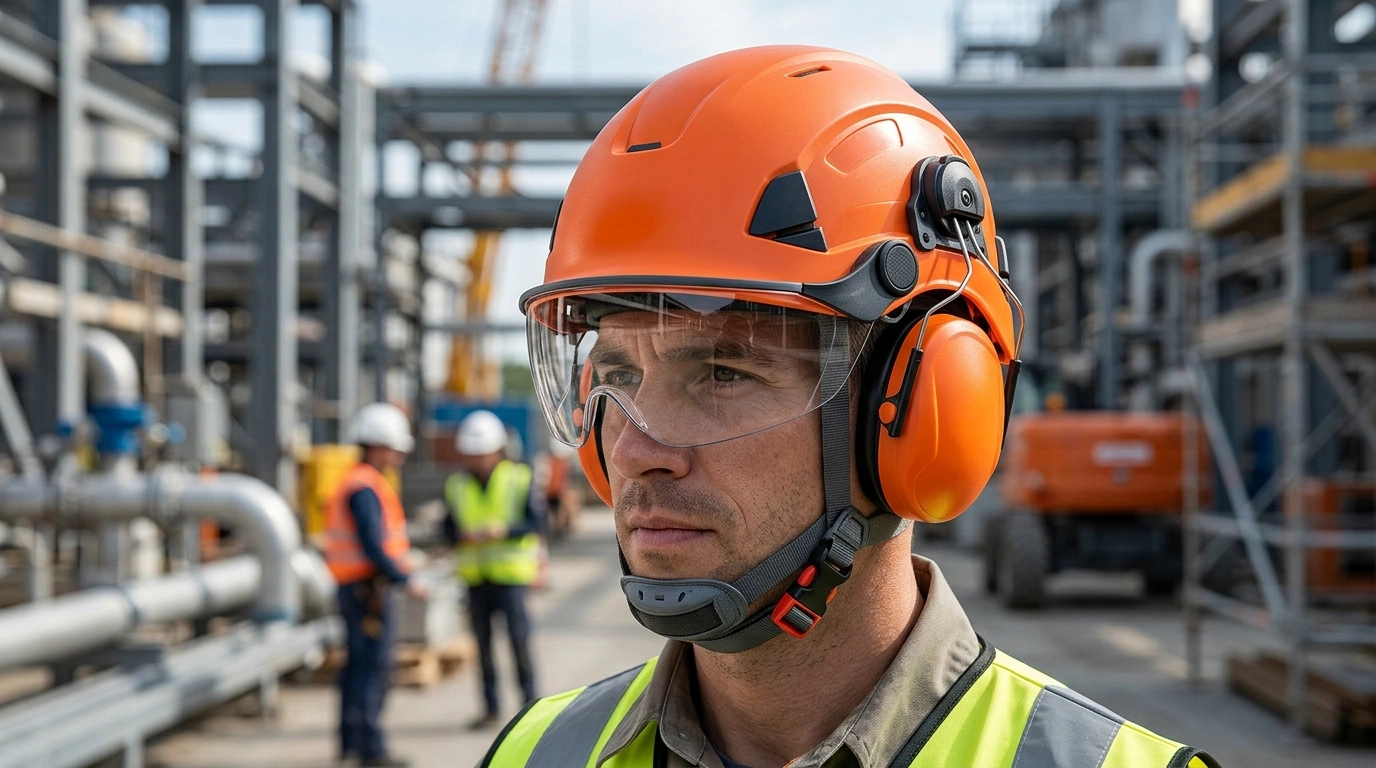
The core function of a safety helmet is to protect the head by reducing the force of impact, helping resist penetration from falling or flying objects, and, in some cases, helping reduce exposure to electrical hazards. In modern workplaces, a safety helmet is much more than a basic hard hat. Depending on its design, it may also provide better retention through a chin strap, improved side protection, and compatibility with other PPE such as face shields, goggles, hearing protection, and communication devices. OSHA’s 2024 bulletin explains that employers should choose head protection based on a hazard assessment, and it recognizes both Type I and Type II protection as well as Class G, Class E, and Class C electrical classes.
That simple definition matters because head injuries on jobsites are often severe. A worker may be exposed to falling objects, struck-by hazards, slips, trips, and falls, contact with fixed structures, or overhead electrical hazards. The right helmet does not make a worker invincible, but it can greatly reduce the risk and severity of injury when it is selected properly, worn correctly, and replaced when damaged. This guide explains what a safety helmet is, how it works, what hazards it protects against, how it differs from a traditional hard hat, and how to choose the right option for the job.
What Is a Safety Helmet?
A safety helmet is a form of personal protective equipment designed for industrial and construction settings where there is a risk of head injury. In everyday conversation, people often use hard hat and safety helmet as if they mean exactly the same thing. In practice, there is overlap, but the market has evolved. Traditional hard hats have long been used for overhead protection, while many newer industrial safety helmets are designed with more secure retention systems, accessory mounting options, and, in many cases, protection against side impacts as well as top impacts. OSHA notes that modern head protection now varies in both style and level of protection, which allows employers and workers to select equipment that matches the job more closely.
The idea is not simply to cover the head. A properly designed helmet is engineered to absorb and redistribute energy in a controlled way. That is why standards matter. In the United States, OSHA points employers toward compliance through ANSI/ISEA Z89.1 editions it recognizes. In Europe, EN 397 is a widely referenced industrial helmet standard, while Indian industry commonly refers to IS 2925 for industrial safety helmets. These standards exist because the purpose of head protection is not symbolic. It is performance-based protection against real workplace hazards.
What Is the Main Function of a Safety Helmet?
The main function of a safety helmet is to reduce the likelihood and severity of head injury. That sounds simple, but it includes several protective jobs happening at once. A helmet helps by taking the first hit from a falling object, by spreading force across the shell instead of letting it concentrate on one small area, and by reducing how much energy reaches the skull and brain. Depending on the model and rating, it may also help protect against electrical shock and against impacts from the side as well as the top. OSHA’s bulletin specifically says proper head protection is crucial in environments with falling objects, struck-by exposure, overhead electrical hazards, and risks from slips, trips, and falls.
This is why the keyword phrase “what is the function of safety helmet” should never be answered with only “to protect the head.” That is true, but incomplete. A more useful answer is this: a safety helmet protects the wearer by absorbing and redistributing impact energy, resisting penetration, improving retention during movement or falls, and in some rated models reducing exposure to electrical hazards. OSHA also notes that some helmets incorporate advanced energy redistribution solutions that help reduce rotational forces, which is important because brain injuries are not always caused only by straight downward impact.
How Does a Safety Helmet Work?
A safety helmet works through a combination of design elements. The outer shell is the first barrier. It helps deflect and distribute the force of impact and resists penetration from sharp or pointed objects. Inside the helmet, the suspension system, padding, or liner helps create space between the shell and the head so that impact energy can be managed before it reaches the wearer. OSHA explains that compliant head protection can be made from materials ranging from high density polyethylene to glass reinforced nylon, and some models use advanced systems to redistribute energy and reduce rotational forces from certain impacts.
Another important feature is the chin strap or retention system. This becomes especially valuable when workers are in awkward positions or exposed to a fall. OSHA says chin straps should be considered with all head protection because they help keep the helmet on during a slip or fall. That matters because a helmet that comes off at the worst moment cannot do its job. NIOSH has also highlighted ongoing research into improved shock absorption performance, including helmet systems with air-bubble cushion liners, showing how modern helmet design is moving beyond the older one-size-fits-all concept of head protection.
Why Head Protection Is So Important at Work?
In high-risk industries, a head injury can change a life in seconds. That is why workplace safety programs treat head protection as essential rather than optional. NIOSH has emphasized the connection between construction helmets and reduction of work-related traumatic brain injury, and one CDC/NIOSH campaign page states that work-related TBI is involved in about 20% of traumatic occupational injuries and 60% of work-related deaths in Washington state. Even when regional numbers vary, the underlying point is clear: the brain is vulnerable, and the consequences of impact can be severe, permanent, or fatal.
That is also why good worker safety practice focuses on more than buying equipment. A helmet must be the right type, the right class, the right fit, and the right condition. HSE guidance says suitable head protection should be in good condition, fit the wearer, be worn properly, and not interfere with other required protective equipment such as hearing protectors. In other words, a helmet only protects well when it is part of a thoughtful safety system.
What Hazards Does a Safety Helmet Protect Against?
A safety helmet is mainly intended to protect against several common workplace hazards. The most familiar are falling objects and flying debris. On a construction site, that may mean tools, materials, fragments, or equipment parts descending from height. In industrial environments, it may mean impact from moving materials or fixed objects. OSHA’s guidance repeatedly frames head protection around these real jobsite hazards, not hypothetical ones.
Helmets may also protect against struck-by hazards and certain side or rear impacts. This is where Type I and Type II become important. Type I head protection is for blows to the top of the head. Type II offers protection from blows to both the top and sides. For jobs involving awkward positions, movement around equipment, or potential lateral impact, that difference can matter a lot.
Another major category is electrical hazards. OSHA identifies Class G head protection as designed to reduce exposure to low-voltage conductors and proof tested at 2,200 volts, while Class E is designed for higher-voltage exposure and proof tested at 20,000 volts. Class C, by contrast, is not intended to protect against electrical hazards. OSHA also makes an important practical point: vented hard hats or safety helmets cannot be used for electrical work. That single detail is one of the most useful selection rules for employers and workers.
Safety Helmet vs Hard Hat: What Is the Difference?
The phrase hard hats vs safety helmets appears often because many employers are reconsidering what kind of head protection their crews should wear. A traditional hard hat has been the standard for decades and is still widely used. In many settings, it remains appropriate. But newer safety helmets often provide a more secure fit, optional chin straps, and a design better suited for keeping the helmet in place during climbing, awkward movement, or a fall. OSHA’s bulletin reflects this evolution by discussing both hard hats and safety helmets as modern head protection options with different capabilities.
The best comparison is not old versus new. It is hazard versus protection. If the main risk is overhead impact, a suitable hard hat may be enough. If the work involves climbing, movement at height, side impacts, or a higher chance the helmet may fall off, a modern safety helmet with chin strap may be the stronger choice. That is why many organizations are shifting from asking “Which one is cheaper?” to “Which one better matches our risk profile?”
Types of Safety Helmets and What the Labels Mean
Understanding helmet labels helps answer not only what a safety helmet does, but what it is rated to do.
| Label | Meaning | Why it matters |
|---|---|---|
| Type I | Protection from impacts to the top of the head | Common for overhead hazards |
| Type II | Protection from impacts to the top and sides of the head | Useful where lateral impact risk is present |
| Class G | General electrical protection, proof tested at 2,200 volts | For reduced exposure to lower-voltage conductors |
| Class E | Electrical protection, proof tested at 20,000 volts | For higher-voltage environments |
| Class C | Conductive; not intended for electrical protection | Do not use where electrical contact is a risk |
| HV / HT / LT | High visibility / high temperature / low temperature markings | Useful for specific environments and tasks |
These ratings come directly from OSHA’s explanation of recognized head protection types and classes. OSHA also notes that HT markings are relevant in high-temperature environments, LT in cold environments, and HV where visibility matters, such as road work or construction zones.
For global audiences, it helps to know that other standards exist too. EN 397 is a key European industrial helmet standard and includes requirements such as shock absorption, penetration resistance, and flame resistance, with optional requirements including very high temperatures and electrical insulation in some contexts. In India, IS 2925 lays down requirements for industrial safety helmets intended to provide protection from falling objects and other hazards in sectors such as mining, tunnelling, quarrying, shipbuilding, and construction projects.
When Is a Safety Helmet Required?
A safety helmet is required whenever the work environment presents a real risk of head injury. OSHA says employers must conduct a hazard assessment to determine whether head protection is necessary and, if so, what type is most appropriate. In practice, that includes many construction sites, manufacturing areas, warehousing operations, road work, maritime tasks, oil and gas worksites, and jobs involving work at height. OSHA specifically references construction sites, the oil and gas industry, working from heights, and electrical work when discussing selection of head protection.
The legal framework matters too. OSHA’s bulletin cites its standards for general industry and construction, including 29 CFR 1910.135 and 29 CFR 1926.100, while HSE guidance in the UK emphasizes that where there is risk from falling objects or striking the head, suitable head protection should be provided and worn. Different regions use different compliance language, but the practical rule is similar: if the risk exists, proper head protection should be on the worker’s head, not hanging from a hook.
How to Choose the Right Safety Helmet for the Job?
The best way to choose the right safety helmet is to start with the hazard, not the product catalog. If a crew works below overhead operations, top-impact protection is crucial. If workers climb, bend, crawl, or move around structural steel, lateral impact protection and a secure retention system may be more important. If the job involves electricity, the helmet class becomes critical, and vented helmets should be ruled out where OSHA says they cannot be used.
Fit and compatibility matter just as much. HSE says suitable head protection should fit the person wearing it and be worn properly, and it should not prevent use of other necessary PPE. OSHA similarly notes that manufacturers offer compatible accessories including face shields, goggles, hearing protection, and communication systems. This means selection should consider the whole PPE setup, not just the helmet shell. A worker doing grinding, chemical handling, welding support, or noisy industrial work may need a helmet that integrates with more than one protective system.
How to Inspect, Store, and Replace a Safety Helmet?
A helmet’s protection depends on its condition. OSHA advises users to inspect the outer shell for cracks, dents, and irregularities; examine the suspension system, headband, and chin strap for wear; and check labels and certification marks to confirm the equipment still meets the needed standard. It also advises workers to make sure the helmet fits securely and to refer to the manufacturer’s guidance on service life.
Storage matters more than many people realize. OSHA says head protection should be cleaned, dried, and kept away from direct sunlight, extreme temperatures, and chemicals that could compromise structural integrity. A helmet should be discarded if it is impacted or shows signs of damage or degradation. HSE guidance similarly says damaged head protection should be thrown away. Another HSE guide notes that, as a general guide, industrial safety helmets should be replaced three years after manufacture, but it also stresses checking the manufacturer’s advice. That nuance is important because there is no single universal lifespan that safely applies to every helmet in every environment.
Common Mistakes People Make With Safety Helmets
One common mistake is choosing the wrong class or type for the hazard. A worker near electrical exposure who grabs a vented helmet or a Class C model may think they are protected when they are not. Another mistake is poor fit. A helmet that is too loose, too tight, or worn incorrectly will not perform as intended. HSE specifically says head protection should fit the wearer and be worn properly, and one HSE publication warns not to wear the helmet sloping up or down because that reduces protection. It also says not to wear it back to front unless it is designed and marked for that use.
A third mistake is treating a helmet as permanent equipment. Even high-quality helmets age, absorb damage, and degrade under heat, UV exposure, chemicals, and daily wear. Some workers also add non-approved accessories or drill holes into the shell, which can compromise performance. The safest habit is simple: use approved accessories only, inspect often, and replace the helmet when damage or manufacturer criteria say it is time.
Can Safety Helmets Help Reduce Traumatic Brain Injury Risk?
Yes, safety helmets can help reduce traumatic brain injury risk, but they do not eliminate all risk. NIOSH has specifically linked modern construction helmets with efforts to reduce work-related traumatic brain injury and is researching improvements in helmet shock absorption performance. OSHA also notes that some head protection designs reduce rotational forces and distribute impact energy to help reduce brain trauma. That makes helmets an important part of TBI prevention, especially where falls, side impacts, or moving equipment are part of the job.
The key point is realistic protection. A helmet is not magic. It works best alongside site controls, training, housekeeping, fall protection, electrical safety, and enforcement of proper wearing rules. In safety terms, PPE is the last line of defense, not the only line. But when that last line is needed, the difference between the right helmet and the wrong one can be enormous.
Final Thoughts
So, what is the function of safety helmet? Its function is to protect the worker’s head by absorbing impact, resisting penetration, helping the helmet stay in place, and, where rated, reducing electrical risk. A good safety helmet supports accident prevention, strengthens workplace safety, and lowers the chance that a momentary incident becomes a lifelong injury. OSHA, HSE, NIOSH, EN 397, and IS 2925 all point in the same direction: choose the right helmet for the hazard, wear it correctly, maintain it properly, and replace it when needed.
The strongest article answer is not just “a helmet protects your head.” It is this: a safety helmet is a performance-based piece of PPE designed to reduce head injury risk in real workplaces, and its effectiveness depends on the right standard, the right fit, the right condition, and the right use. That is why it matters more than ever on modern jobsites.
Disclaimer: This article is for general safety and informational purposes only. Workplace risks and safety requirements may vary by job, industry, and regulations. Always follow official safety guidelines and consult qualified safety professionals.













Leave a Reply