

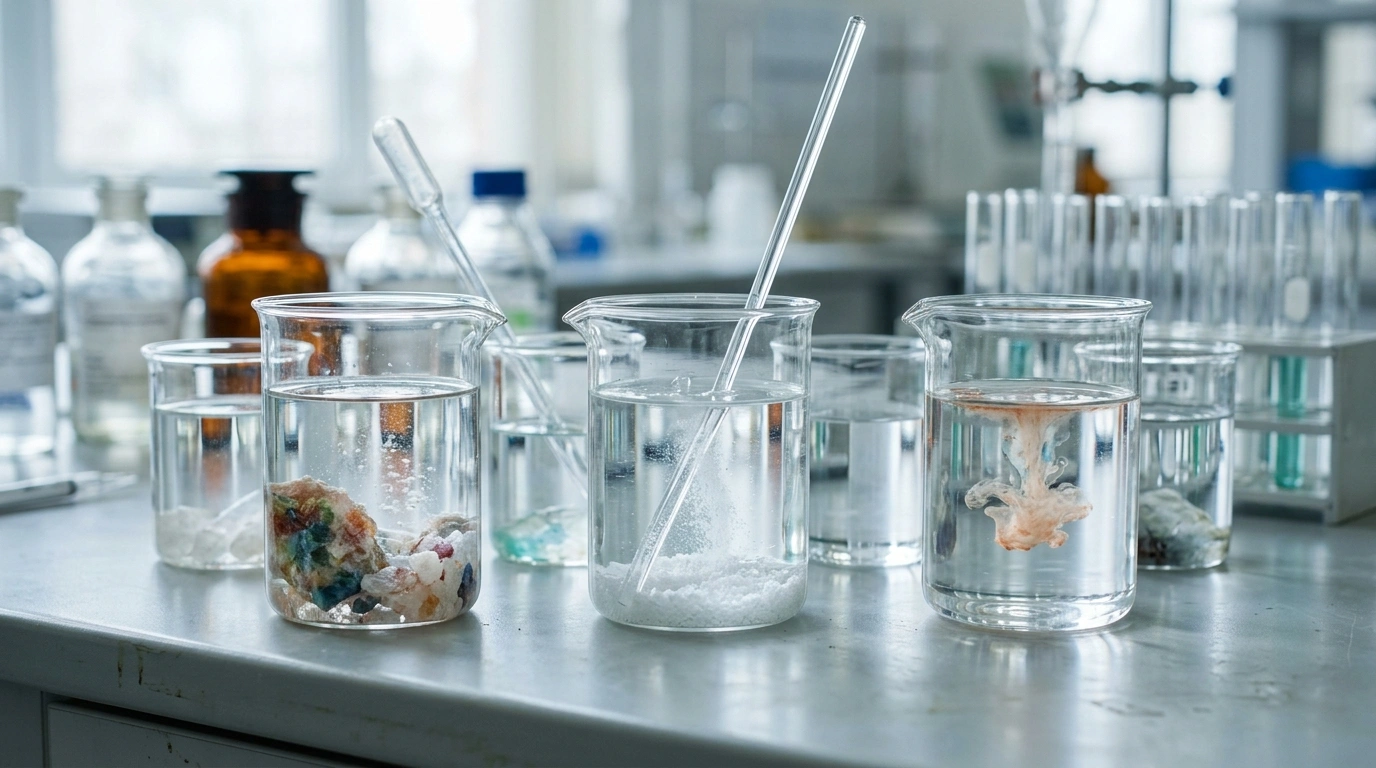
Why water called the universal solvent is a common science question, and the short answer is this: water can dissolve more substances than any other common liquid, which makes it incredibly important for life on Earth, the human body, and the natural world. That is why water is often called the universal solvent in chemistry.
Still, there is more to the story. Water is not magic, and it does not dissolve everything. It works so well because the H2O molecule has a special structure. It has two hydrogen atoms and one oxygen atom, and that shape gives it molecular polarity, partial charges, and strong solute-solvent interactions. These features help water molecules pull apart ions, surround certain molecules, and form a stable solution.
In simple words, water is called the universal solvent because it is unusually good at dissolving many solids, liquids, and gases. This matters in everything from blood plasma carrying nutrients to rivers moving minerals, from plant roots absorbing dissolved substances in soil to the kidneys filtering waste. Understanding why is water called the universal solvent also helps explain why salt dissolves in water, why many polar molecules mix with it easily, and why oil stays separate.
What Does “Universal Solvent” Actually Mean?
The phrase universal solvent sounds absolute, but in science it is really a practical label. It means water can act as a solvent in many different solutions and can dissolve a very wide range of substances. In a solution, the substance doing the dissolving is the solvent, and the substance being dissolved is the solute.
So when someone asks, why is water called a universal solvent, they usually want to know why water performs better than most other liquids in making a homogeneous solution. A homogeneous solution is one in which the dissolved particles are spread evenly throughout the liquid. That is what happens when salt dissolves in water or when sugar mixes into tea or coffee.
A good one-line answer for students is this: Water is called the universal solvent because it dissolves more substances than any other common liquid. That answer is correct, but it becomes much more useful when you also explain why that happens. The real science lies in water polarity, hydrogen bonding, and the way H2O interacts with charged particles and polar molecules.
The Main Reason Water Dissolves So Many Substances
The biggest reason water universal solvent is such a famous idea comes down to molecular polarity. A water molecule may look simple, but it has a very important internal structure. The oxygen atom pulls shared electrons more strongly than the hydrogen atoms do. This difference in electronegativity creates partial charges inside the molecule.
That means one side of H2O has a slight negative electrical charge, while the other side has a slight positive electrical charge. This uneven distribution of charge is called a dipole moment, and it is why water is a polar molecule.
Because water molecules are polar, they are strongly attracted to other charged particles and to many polar molecules. This is one of the key water solvent properties. Instead of behaving like a neutral liquid with no preferred interactions, water actively pulls, surrounds, and stabilizes many kinds of dissolved particles.
The shape of the molecule matters too. Water is not a straight molecule. Its bond angle is often described as about 104.5°, and that bent shape helps create its polar arrangement. This is one reason the chemical composition of water leads to such useful behavior. Even though H2O is tiny, its structure gives it powerful intermolecular forces.
Another reason water is such an excellent solvent is its ability to form hydrogen bonds. A single water molecule can participate in multiple hydrogen bonding interactions, which makes liquid water highly connected and highly responsive to dissolved substances. You could say that water is built to interact.
This is why why is water considered the universal solvent in science has such a clear answer. Water does not dissolve many substances by accident. It does so because its positive and negative charge distribution makes it naturally good at stabilizing dissolved particles.
How Water Dissolves Salt and Other Ionic Compounds
If you want to understand why salt dissolves in water at the molecular level, sodium chloride is the perfect example. Salt, or NaCl, is made of sodium ions and chloride ions held together by an ionic bond. In solid form, these ions are packed into a crystal structure.
When water molecules surround that crystal, the slightly negative side of H2O is attracted to the positive sodium ion, while the slightly positive side is attracted to the negative chloride ion. This is how water molecules pull sodium and chloride ions apart. Over time, the attraction between water and the ions becomes strong enough to weaken and overcome the ionic bond in the crystal.
As the ions separate, each one becomes surrounded by water molecules. This layer of surrounding water is called a hydration shell. The formation of this shell is a major reason how water dissociates ionic compounds into positive and negative ions becomes possible. The process is often supported by hydration energy, which helps stabilize the separated ions in an aqueous solution.
Here is a simple table that shows the idea:
| Substance | Type | What Water Does | Result |
| NaCl (salt) | Ionic compound | Surrounds sodium and chloride ions | Salt dissolves in water |
| Sugar | Polar molecule | Forms attractive interactions with water | Dissolves easily |
| Oil | Nonpolar substance | Has weak attraction to water | Does not mix well |
This is one of the clearest examples of dissolves more substances than any other liquid. Many ionic compounds can dissolve because water is so effective at separating and stabilizing ions. That is why salt dissolves in water is one of the first examples taught in chemistry.
Why Water Also Dissolves Many Polar Molecules
The science does not stop with salts. Water also dissolves many polar molecules, which is another reason it is known as the universal solvent in chemistry. This is where the phrase like dissolves like becomes very helpful.
In simple terms, like dissolves like means polar substances tend to dissolve well in polar solvents, and nonpolar substances tend to dissolve better in nonpolar solvents. Since water polarity makes water a strongly polar liquid, it does a great job dissolving many polar substances.
For example, glucose, some alcohol molecules such as ethanol, and glycerol can dissolve well because they can form favorable solute-solvent interactions with water. In many cases, hydrogen bonding plays a big role. Water does not just passively sit around these molecules. It forms attractions that help keep them dispersed evenly in a solution.
That is why real life example of water as a universal solvent can include much more than salt. Think about tea, coffee, soup, or dissolved nutrients in the body. Water helps carry flavor compounds, sugars, and other dissolved materials in forms the body or environment can use.
This section is important because many shorter explanations only say water dissolves salt and stop there. A stronger article should explain that water is also highly effective with many polar molecules, not just ions.
Why Water Is Not a True Universal Solvent
A smarter and more accurate article must also explain why water does not dissolve everything. Even though water is called the universal solvent, no true universal solvent exists.
This matters because students often misunderstand the term. They hear universal solvent and assume water can dissolve every material. That is not correct. Water is best described as a selective solvent rather than a true universal solvent.
The biggest reason is that nonpolar molecules do not interact strongly with water. Substances such as oil, fats and oils, fats and waxes, and some organic compounds are often hydrophobic, which means they do not mix well with water. In contrast, substances that interact well with water are often called hydrophilic.
This explains why oil and water do not mix. Oil lacks the strong charge separation that helps water molecules interact with dissolved particles. Since there is no strong attraction, the water molecules stay mostly attracted to each other instead of pulling the oil apart into a stable mixture.
So if someone asks why water dissolves salt but not oil, the answer is that salt contains ions that water can attract and separate, while oil is largely nonpolar and lacks those strong interactions. The same logic helps explain why nonpolar molecules do not dissolve well in water and why water cannot dissolve oils or plastic.
This “myth-busting” section gives your article an edge because it adds precision. Saying water universal solvent is fine, but explaining its limits makes the content stronger and more trustworthy.
Why Water’s Solvent Power Matters in the Human Body
The reason water matters so much is not just chemistry class. Its solvent power is essential to biology. Much of the human body depends on water-based transport. Blood plasma is mostly water, and it helps move nutrients, minerals, hormones, and waste products where they need to go.
Inside cells, the cell cytoplasm is largely an aqueous environment. Many biochemical reactions happen there because dissolved substances can move, collide, and react more easily. Without water acting as a solvent, these reactions would be far slower or impossible.
This is also why how water carries valuable chemicals minerals and nutrients is such an important idea. The body uses dissolved materials constantly. Carbon dioxide, salts, sugars, and many other substances are transported in water-rich fluids. The kidneys also rely on water’s solvent ability to help filter waste out of the blood.
Here is a simple way to think about it:
Water is called the universal solvent not just because it dissolves things in a lab, but because it helps living systems work every minute of every day.
That is especially true for water-based life. From the smallest cells to the whole body, water’s role as a solvent supports transport, balance, and metabolism.
Why Water’s Solvent Properties Matter in Nature and Everyday Life
The same principle works outside the body too. In soil, dissolved minerals and nutrients become available to plants through water. In rivers and other water systems, dissolved substances move through ecosystems and shape the chemistry of habitats. In the water cycle, rainwater picks up and carries materials from the atmosphere and the ground.
This is one reason life on Earth depends so heavily on water resources. Water helps distribute useful substances, supports aquatic life forms, and connects chemical processes across the environment. In agriculture, dissolved fertilizers move through wet soil. In homes, water helps with washing, cleaning, and food processing. In cooking, soups, broths, teas, and other liquids depend on water’s ability to dissolve and carry substances.
A simple case study is plant nutrition. Plant roots absorb water from the ground, but they are not absorbing pure water alone. They are often taking in water that contains dissolved ions and nutrients. Without this, plant growth would be severely limited.
Another everyday example is cleaning. Many cleaning products work because water can surround and carry away certain materials. On its own, water may not remove greasy hydrophobic substances very well, but with soap or detergent, it becomes much more effective. That comparison also reinforces the idea that water is powerful, but not all-powerful.
Key Properties That Make Water an Excellent Solvent
By this point, the answer to why is water the universal solvent should be clear. Still, it helps to summarize the main properties that make water such an excellent solvent.
First, water is a polar molecule. Its positive electrical charge and negative electrical charge regions allow it to interact strongly with ions and many polar molecules.
Second, hydrogen bonding gives water extra strength as a solvent. These interactions help stabilize dissolved substances and improve solubility.
Third, water has a relatively high dielectric constant, which helps reduce the attraction between opposite charges in ionic compounds. In simple terms, this makes it easier for water molecules to separate ions and keep them apart in solution. You can think of this as a kind of dielectric screening.
Fourth, water forms effective hydration shells around dissolved ions. Once those ions are surrounded, they become much more stable in solution.
Finally, water supports many important chemical and physical processes, including transport, reaction, and exchange. Even related ideas like electrical conductivity, self-ionization, and reactivity show that properties of water go far beyond being “just a liquid.”
Simple Examples Students Can Use in Homework or Exams
Many readers searching this topic want a ready-to-use answer. Here are three easy versions.
One-line answer:
Water is called the universal solvent because it can dissolve more substances than any other common liquid.
Short paragraph answer:
Water is called the universal solvent because its polar molecules can attract and surround many dissolved particles. This helps it dissolve many ionic compounds and polar molecules, such as salt and sugar. Water is very important in nature and in the body because it carries nutrients, minerals, and other substances.
Slightly longer science answer:
Why is water called the universal solvent because it dissolves more substances than any other liquid is explained by the structure of H2O. A water molecule has two hydrogen atoms and one oxygen atom, giving it molecular polarity. This allows water to pull apart ions, form hydrogen bonds, and create stable solutions. However, water does not dissolve everything, especially nonpolar substances like oil.
These versions help capture both student intent and broader SEO value.
Frequently Asked Questions About Water as the Universal Solvent
Is water really a universal solvent?
Not in a literal sense. Water is called the universal solvent because it dissolves a huge number of substances, but no true universal solvent exists. Water still struggles with many nonpolar molecules.
What property of water makes it a good solvent?
The most important property is polarity. Because water molecules have partial charges, they can interact strongly with ions and many polar substances. Hydrogen bonding also helps.
Why does water dissolve salt but not oil?
Salt contains charged ions, such as sodium ions and chloride ions, that water can attract and separate. Oil is largely nonpolar, so it has weak attraction to water and does not mix well.
Does water dissolve solids, liquids, and gases?
Yes, water can dissolve solids liquids and gaseous substances. It can dissolve many salts and sugars, some liquids like certain alcohols, and gases such as carbon dioxide and oxygen gas to some extent.
Why is water important in the body and nature?
Because it dissolves and carries useful materials. In the body, it helps transport nutrients, waste, and chemicals through blood plasma and other fluids. In nature, it helps move dissolved substances through soil, rivers, and ecosystems.
Conclusion: The Real Reason Water Is Called the Universal Solvent
Why is water called the universal solvent has a simple answer and a deeper one. The simple answer is that water dissolves more substances than any other common liquid. The deeper answer is that H2O has a special molecular structure that gives it polarity, supports hydrogen bonding, and allows strong interactions with ions and many polar molecules.
That is why water universal solvent remains one of the most important ideas in basic chemistry. It helps explain how salt dissolves in water, how nutrients move through the body, how plants absorb minerals from soil, and why life on Earth depends so heavily on water.
At the same time, a complete answer should also remember the limitation: water does not dissolve everything. It is best understood as a remarkably powerful, highly selective solvent rather than a true universal solvent. That balance of simplicity and accuracy is what makes this topic so useful for students, teachers, and curious readers alike.
Disclaimer: This article is for general educational and informational purposes only. Scientific explanations may be simplified for clarity. For detailed study or academic use, refer to official textbooks or qualified educators.














Leave a Reply