

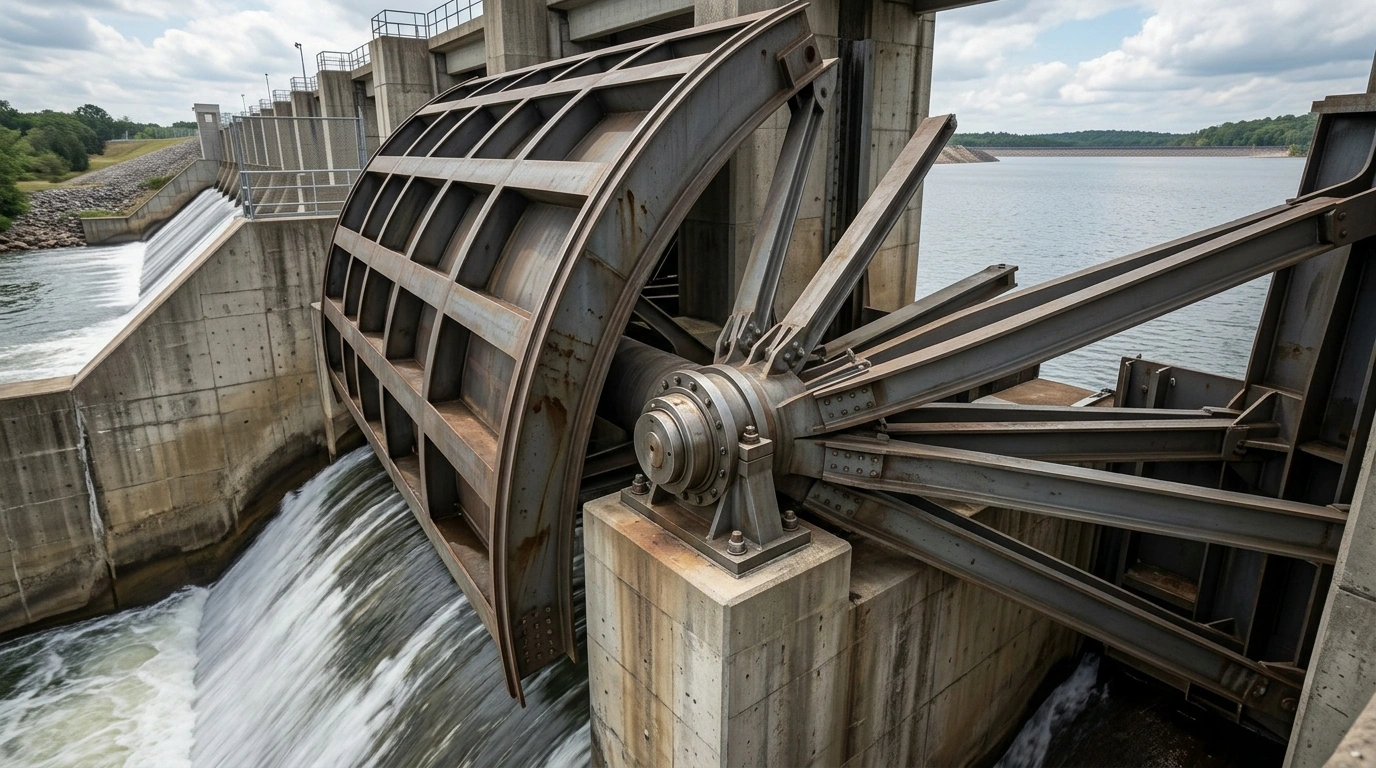
The radial gates rotate about their horizontal trunnion axis, also called the trunnion pins or trunnion bearings. That is the short, correct answer most students, exam takers, and civil engineering readers are looking for. A radial gate—often called a Tainter gate—is a curved water-control gate used in dams, spillways, barrages, reservoirs, and canal structures to regulate flow and water level. Manufacturers and engineering references consistently describe the gate as a curved structure supported by radial arms and trunnion bearings, which allow it to rotate smoothly during operation.
This matters because the keyword is not just about a definition. It sits inside a wider topic cluster that includes water flow control, spillway gates, hydromechanical equipment, radial gate working principle, radial gate parts and functions, radial gates vs vertical gates, and applications in hydraulic structures. Most competitor pages explain the product, but they do not clearly center the article on the exact educational question behind the search. That gives this article a strong SEO edge.
What Is a Radial Gate?
A radial gate is a curved gate designed to control the flow and level of water in structures such as dam spillways, river barrages, reservoir outlets, and canal systems. One source describes it as a gate used in dams, barrages, and canal structures with a curved skin plate supported by radial arms and trunnion bearings. Another describes the radial gate, or Tainter gate, as a floodgate used to control water flow through dams’ spillways and river barrage works.
What makes this gate different from many other gate types is its shape and movement. Instead of moving straight up and down like many vertical gates, a radial gate rotates in an arc. That curved shape is not just for appearance. It helps the gate handle water pressure more efficiently and often reduces structural demand compared with flatter gate forms. BIC’s comparison page specifically notes that radial gates have a curved, arched surface that spreads pressure more efficiently across the gate.
In practical SEO terms, this is why the topic supports many related keywords naturally: radial gates, tainter gates, water management systems, hydraulic engineering gates, spillway gates, and water level control. A reader may come for the direct answer, but they usually stay because they also want to understand how radial gates work in spillways and dams.
Radial Gates Rotate About Their Horizontal Trunnion Axis
The most accurate direct answer is this: radial gates rotate about their horizontal trunnion axis. On real structures, that axis is formed by the trunnion assembly, which includes the trunnion pins or trunnion bearings mounted into the side supports of the structure. Persistent Projects explains that the gate is supported by radial arms and trunnion bearings, allowing the gate to rotate smoothly. Ševčík HYDRO similarly describes the damming body as part of a cylindrical area with a rotation axis, with loads transferred through segment arms and bearings to the structure.
So if you are answering an exam, interview, viva, or radial gate MCQ, the best short answer is:
Radial gates rotate about their horizontal trunnion axis or trunnion pins.
That phrasing is stronger than a vague answer such as “about their hinges,” because trunnion is the specific engineering term readers are often expected to know. The side piers, concrete walls, or adjacent supporting structure hold the trunnion system in position, while the curved gate body swings during opening and closing. Vortex Hydra describes the gate as connected through a frame-mounted trunnion to the concrete structure, while Persistent Projects places the trunnions in the side supports.
This is also where the strongest gap keywords fit naturally: what is a trunnion axis, horizontal trunnion axis meaning, trunnion bearing function in radial gates, and what are trunnion pins in radial gates. Those phrases match the real intent behind the search better than product-only pages do.
Main Parts of a Radial Gate
To understand the radial gate working principle, it helps to know the main parts. Across competitor pages, the repeated components are the curved skin plate, radial arms, trunnion bearings, supporting beams, seals, and the operating or hoisting arrangement. Persistent Projects uses the terms curved (circular arc) skin plate, radial arms, and trunnion bearings. Ševčík HYDRO adds stringers, crossbars, segment arms, self-lubricating bearings, and the main carrying system. Vortex Hydra also refers to the gate’s structural members, sealing system, and lifting systems.
Here is a simple table that turns those technical terms into plain English:
| Part | What it does |
|---|---|
| Skin plate / curved skin plate | Holds back water and forms the curved gate face |
| Radial arms / segment arms | Transfer loads from the gate face toward the support point |
| Trunnion / trunnion bearings | Form the rotation axis and support the gate while it moves |
| Stringers / crossbars / beams | Reinforce the gate body and help distribute pressure |
| Seals | Improve watertight closure and reduce leakage |
| Hoist / hydraulic cylinder / winch | Opens and closes the gate |
This structure explains why terms like main components, radial arms, curved skin plate, self-lubricating bearings, rubber seals, neoprene seals, horizontal beams, and vertical beams are all important secondary and LSI keywords for the article. The gate is not one solid plate. It is a coordinated hydromechanical system designed to resist water pressure and move in a controlled way.
How a Radial Gate Works
A radial gate works by rotating around the trunnion axis rather than moving vertically. During operation, the opening system—such as a hydraulic cylinder, hydraulic servomotor, electric hoist, or electric winch—moves the gate into the required position. Vortex Hydra and its production page both mention hydraulic and electric operating options, while BIC notes that radial gates rotate to regulate flow and can be set at different positions depending on flow-control needs.
Because the gate is curved, water pressure is handled differently than it is on a flat gate. Instead of forcing a large flat surface to resist the whole load in the same way, the curved arrangement helps distribute the pressure and transfer load through the radial arms into the trunnion and then into the supporting structure. Ševčík HYDRO explicitly describes the load path from the damming plate through the reinforced system and segment arms to the bearings and then to the structure.
This is why SEO phrases such as radial gate working principle with curved face, opening and closing operations, pressure management, load transmitted to structure, and circular rotation fit naturally here. It is also why radial gates are associated with large flow capacity and efficient water flow control in spillway settings. BIC’s spillway materials describe radial gates as effective in spillways and suitable for large flows.
Why Radial Gates Are Curved
One of the most useful beginner questions is also one that competitors do not explain clearly enough: why are radial gates curved? The answer is that the curved, arched surface helps the gate handle water pressure more efficiently and direct loads toward the structural supports. BIC states plainly that the curved surface allows radial gates to better handle water pressure because it is spread more evenly across the gate. Vortex Hydra’s production page similarly says radial gates are curved in vertical section to better resist water pressure.
This has real engineering value. A better pressure path can reduce unnecessary bending stress, improve structural stress behavior, and make the gate more practical for large spans or high-head applications. Persistent Projects also emphasizes advantages tied to load behavior, lower power needs, and suitability for larger hydraulic structures.
So when you use gap keywords like why radial gates are curved or how load is transferred in a radial gate, you are not stuffing the article. You are filling the exact explanation gap that searchers and students often have.
Where Radial Gates Are Used
Radial gates are widely used in dams, spillways, river barrages, weirs, reservoir systems, canal head regulators, diversion works, irrigation structures, and powerhouse intakes. Persistent Projects lists many of these applications directly, and Vortex Hydra repeatedly ties radial gates to dams’ spillways and river barrage use.
These locations all have one thing in common: they need controlled, reliable management of flowing water. In some cases the goal is flood control. In others it is water supply, irrigation, maintaining reservoir level, power generation, or even helping manage downstream flow conditions. Vortex Hydra’s production article mentions uses such as drawing off water for irrigation, water supply, generating power, and evacuating water and silt from reservoir areas.
That makes this section a natural home for terms like dam spillways, flood control structures, diversion works, reservoirs, canals, water level control, and minimum flow in the river. It also improves topical authority for broader water resources engineering and hydraulic structures searches.
Radial Gate vs Vertical Gate
A useful comparison section can strengthen rankings because many readers want to know whether a radial gate is the same as a vertical gate. It is not. A radial gate rotates about a pivot or trunnion axis, while a vertical gate generally moves upward and downward. BIC’s comparison article is built around that distinction and contrasts curved, arched radial gates with flat rectangular vertical gates.
The practical difference is important. A radial gate is often favored where large volumes of water must be managed efficiently and where the curved shape helps with pressure distribution. A vertical gate may be simpler in some arrangements and is useful where straight vertical movement suits the structure better. BIC specifically links radial gates to larger and higher-pressure water management settings, while vertical gates are described as suitable for smaller or more straightforward systems.
Here is a clear comparison:
| Feature | Radial Gate | Vertical Gate |
|---|---|---|
| Movement | Rotates about trunnion axis | Moves up and down |
| Shape | Curved / arched surface | Usually flat / rectangular |
| Pressure handling | Efficient distribution | More direct flat-face loading |
| Typical use | Spillways, large water-control works | Various control points, including simpler systems |
This section gives room to use primary and long-tail terms like radial gates vs vertical gates, difference between radial gates and vertical gates, advantages of radial gate over vertical lift gates, and vertical gates move up and down to control water flow.
Advantages of Radial Gates
The biggest advantages of radial gates come from their geometry and movement. Because they are curved and supported at the trunnion, they can provide efficient pressure management, smoother operation, and practical performance in large spans and high-head applications. BIC says the curved design spreads pressure efficiently and can make the structure lighter. Persistent Projects also presents radial gates as suitable for large spans and heavy-duty water-control use.
Another advantage is controllability. Radial gates can often be positioned with precision, which helps regulate discharge rate and water level. BIC notes that radial gates can be positioned at different angles to regulate discharge, and Ševčík HYDRO highlights high controllability for some radial gate variants.
From an SEO angle, this section is perfect for advantages of radial gate, radial gates for high-pressure water management, quicker opening and closing, lower power requirement, service life, and high controllability.
Types of Radial Gates
Not every radial gate is identical. Ševčík HYDRO identifies several types, including lift radial gates, release radial gates, flap radial gates, and two-piece radial gates. It explains that some variants control the upper water level by outflow under the body, while others work by overflow over the damming body. It also notes that some types are designed for large damming heights and greater controllability.
This section helps the article move beyond the basic definition and cover a richer semantic field. It also lets you naturally include terms like overflow, upper water level, outflow under the body, two-piece radial gates, and flap radial gates for large damming heights. Competitors rarely explain these types in a way that is easy for students, so turning them into plain language adds value.
Design Considerations and Technical Details
Real radial gate design depends on factors such as hydrostatic pressure, hydrodynamic pressure, self-weight, hoisting load, site geometry, and the surrounding civil works. Persistent Projects includes a design-focused section, while Vortex Hydra discusses adapting radial gates to existing site conditions, support configurations, and different operating arrangements.
Some competitor pages also include highly technical details and digit-based entities such as UNI EN ISO 9001, DN 2000, DN2200, PN 10, PN6, and references to product production dates or projects. These are not the main search intent, but they can strengthen authority when used lightly in a technical section. For example, Vortex Hydra presents its quality and production capabilities around hydromechanical equipment, while Ševčík HYDRO and related pages mention dimensional and pressure-rating style references in associated waterworks products.
A good article should not overload readers with specification jargon, but it should mention that real gates are engineered systems with bearings, seals, hoists, structural reinforcements, and site-specific design requirements.
Simple Exam Answer and Short Note
If you need a short academic response, use this:
Answer: Radial gates rotate about their horizontal trunnion axis or trunnion pins.
Short note: A radial gate is a curved gate used in dams, spillways, barrages, and canal structures to control water flow and water level. It is supported by radial arms and trunnion bearings, which allow it to rotate smoothly. The curved surface helps the gate handle water pressure more efficiently than a flat gate in many applications.
That short format works well for a radial gate objective question, viva, interview, or short note prompt.
A Small Practical Example
Imagine a spillway on a reservoir during heavy inflow. Operators need a gate that can open in a controlled way, handle high water forces, and regulate the discharge rate. A radial gate fits that job well because it can be positioned at different openings and its curved surface is designed for efficient pressure handling. BIC’s spillway material and Vortex Hydra’s production description both support this kind of use case for large water-control structures.
This is why radial gates show up repeatedly in discussions of spillway gates, flood-control structures, river barrage works, and reservoir management rather than only in narrow product catalogs.
FAQ About Radial Gates
Is a radial gate the same as a Tainter gate?
Yes, competitors often use radial gate and Tainter gate interchangeably. Vortex Hydra explicitly calls the radial gate a Tainter gate.
What do radial gates rotate about?
They rotate about their horizontal trunnion axis, formed by the trunnion pins or trunnion bearings.
Why are radial gates curved?
The curved surface helps distribute water pressure more efficiently and improves structural behavior.
Where are radial gates commonly used?
They are commonly used in dams, spillways, barrages, reservoir outlets, canal structures, and related water management systems.
Are radial gates better than vertical gates?
Not in every case. They are often very effective for spillways and large-flow control, while vertical gates may suit other layouts better. The right choice depends on hydraulic and structural needs.
Conclusion
The direct answer is simple, but the full topic is richer than it first looks. Radial gates rotate about their horizontal trunnion axis, and that single fact explains their movement, load path, and usefulness in real hydraulic structures. Because the gate is curved and supported through radial arms and trunnion bearings, it can regulate water efficiently in spillways, dams, barrages, reservoirs, and canal systems.
For SEO, this topic performs best when the article answers the exact question immediately, then expands into radial gate parts and functions, working principle, why the gate is curved, applications, types, and comparison with vertical gates. That is the clearest way to satisfy both the search engine and the reader.
Disclaimer: This article is for general educational and informational purposes only. Engineering concepts and applications may vary based on design, site conditions, and standards. Always refer to qualified engineers or official guidelines for accurate technical use.















Leave a Reply