

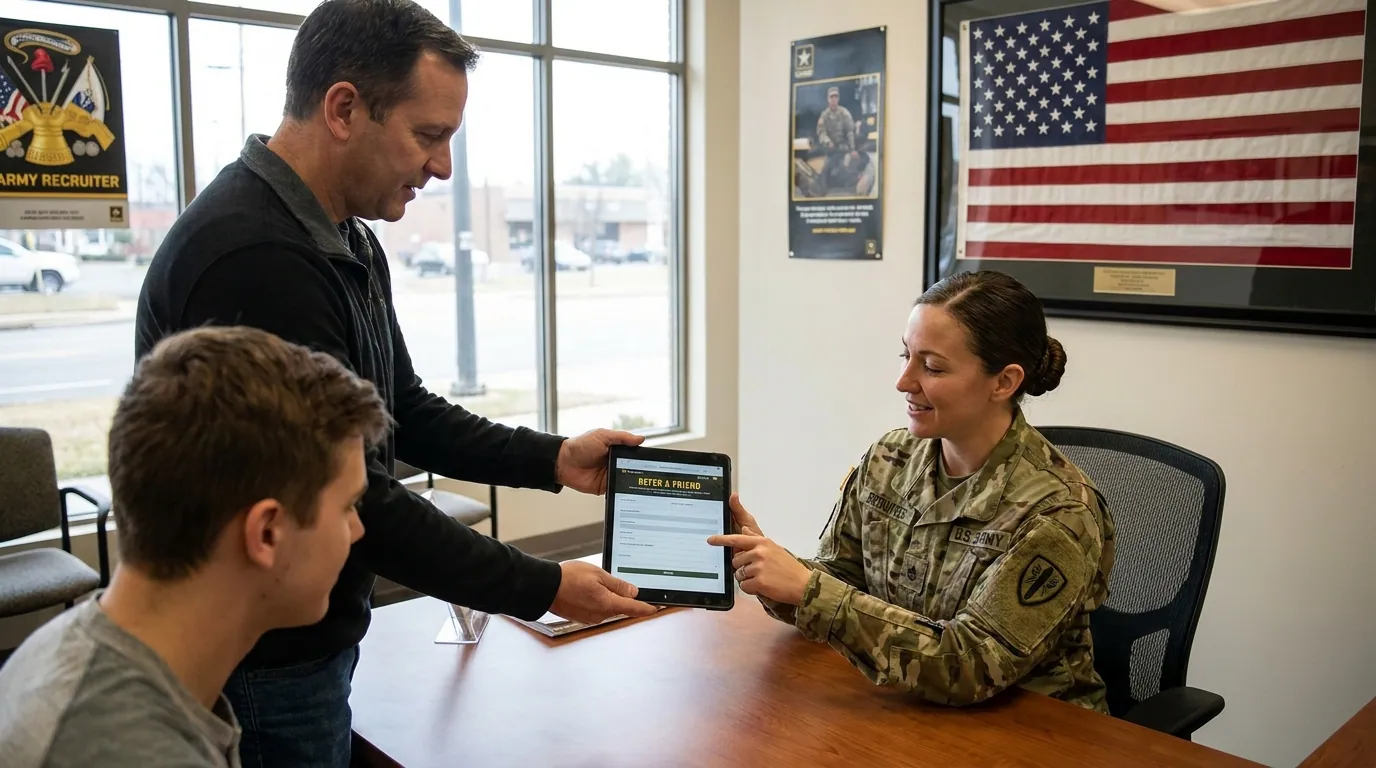
How to refer someone in the army is a common question for Soldiers, Future Soldiers, family members, friends, and civilians who know someone interested in military service but are unsure how the Army referral process works. In simple terms, referring someone means connecting an interested person with an official Army recruiter or an approved Army referral form so they can learn about eligibility, jobs, benefits, training, and enlistment.
The process can vary depending on whether you mean the U.S. Army, Army Reserve, Army National Guard, British Army, or another country’s army. In the U.S., referrals may connect to the Soldier Referral Program, Future Soldier referral, GoArmy referral form, or National Guard referral form. In some cases, a valid referral may also help eligible Soldiers earn rank advancement, the Army Recruiting Ribbon, or promotion points.
This guide explains how to refer someone to the Army, what information you need, what counts as a valid referral, and what happens after the referral is submitted.
How to Refer Someone to the Army: Quick Answer
The easiest way to refer someone to the Army is to use an official Army referral channel, such as a recognized recruiting website, a local recruiting station, or an Army recruiter. For the U.S. Army, this often means using the GoArmy referral form, contacting a recruiter directly, or sharing the official recruiting link with the person who is interested in serving.
A basic Army referral step-by-step guide looks like this:
- Confirm the person is interested in learning about the Army.
- Get their permission before submitting their name or contact details.
- Collect the needed information, such as the applicant’s name, phone number, email, and your own referrer details if required.
- Submit the referral through an official Army referral form, recruiter, or approved platform.
- Wait for an Army recruiter follow-up.
- If you are seeking referral credit, ask how to track the referral through official channels.
The most important thing is to avoid submitting someone’s information without consent. A referral should be helpful, not pushy. You are not forcing someone to enlist; you are simply helping them connect with a recruiter who can explain Army service, career training, education benefits, pay and benefits, and the full Army application process.
What Is the Army Referral Program?
The Army Referral Program is a recruiting-support system that allows certain people, especially Soldiers and Future Soldiers, to refer qualified individuals who may be interested in joining the Army. In the U.S. Army context, this is often connected to the Soldier Referral Program, also called SRP, and the broader idea of support recruiting.
The purpose is simple: people who already know the Army can help identify motivated recruits and encourage them to speak with an official recruiter. The Army often says that Soldiers can share their Army story, explain the value of service, and help bring in the next generation of leaders. This makes referrals part of the larger Army recruiting mission and the idea that quality attracts quality.
However, a referral is not the same as being a recruiter. The actual recruiter handles eligibility screening, the ASVAB test, medical review, the MEPS process, job selection, enlistment paperwork, and the final contract. The referrer simply helps make the connection.
Depending on the program, a referral may lead to rewards and recognition, such as the Army Recruiting Ribbon, promotion points, or rank advancement. These benefits are not automatic. They depend on the current rules, the referrer’s status, and whether the referred person becomes a qualified referral.
Who Can Refer Someone to the Army?
Many people can encourage someone to speak with an Army recruiter, but not everyone will qualify for official referral credit. This is where users often get confused.
In general, the following people may be able to refer someone:
| Referrer Type | Can They Refer? | Notes |
| Active duty Soldiers | Yes | May qualify for official referral credit depending on program rules |
| Army Reserve Soldiers | Yes | May be included in certain referral programs |
| Army National Guard Soldiers | Yes | May use Guard-specific referral channels |
| Future Soldiers | Yes | May refer a friend before shipping to training |
| Veterans | Sometimes | Can usually connect someone to a recruiter, but rewards may vary |
| Family members or civilians | Usually yes informally | They can encourage contact with a recruiter, but may not receive official military credit |
A Future Soldier referral is especially important because some Future Soldiers may qualify for advanced enlistment rank if they refer someone who enlists before they ship to Initial Military Training. This is different from a current Soldier seeking an Army Recruiting Ribbon or promotion points.
For Soldiers, eligibility may depend on rank or grade. Terms like E-1, E-2, E-3, E-4, and E-5 often appear in referral guidance because benefits may differ for junior enlisted Soldiers, Specialists, and Sergeants. For example, some junior enlisted Soldiers may be eligible for one rank advancement, while certain E-4 or E-5 Soldiers may qualify for promotion points through the ribbon system.
Army Referral Checklist: What Information Do You Need?
Before you submit an Army referral, prepare the correct details. A referral can be delayed, rejected, or hard to track if the information is missing or inaccurate.
Here is a simple Army referral checklist:
| Information Needed | Why It Matters |
| Referrer’s first and last name | Identifies who made the referral |
| 10-digit DoD ID number | Helps verify military service connection when required |
| Referrer phone number or email | Allows follow-up if there is a question |
| Applicant’s full name | Identifies the person being referred |
| Applicant’s phone number or email | Allows the recruiter to contact them |
| Applicant consent | Confirms they are open to being contacted |
| Preferred Army component | Active duty, Army Reserve, or Army National Guard |
| Basic interest area | Helps the recruiter discuss possible Army roles or MOS options |
The DoD ID, also called a Department of Defense identification number, is especially important for some U.S. Army and National Guard referral systems because it may serve as proof of service. If you enter the wrong Army referral DoD ID, the referral may be difficult to credit correctly.
The most overlooked item is applicant consent. Even if the person is your friend, spouse, classmate, or family member, it is best to ask first. A respectful referral protects the applicant’s privacy and makes the recruiter’s first contact more welcome.
Step-by-Step: How to Submit an Army Referral Online
If you want to know how to refer someone in the army online, the process is usually simple when you use official channels. The exact steps may vary, but this general process works for most referral situations.
First, speak with the person you want to refer. Ask whether they are actually interested in learning about the Army, Army Reserve, or Army National Guard. Do not submit their personal details just because you think they would be a good fit. The best referrals come from people who are already curious about service.
Next, collect the basic information. You may need your first and last name, your 10-digit DoD ID number, your contact details, and the applicant’s phone number or email. If the person is interested in the U.S. Army, use an official channel such as a recruiter, GoArmy referral page, GoArmy refer a friend pathway, or approved Army referral contact form. Some official guidance may also mention an Army referral QR code or text-based referral option, such as texting a referral keyword to GOARMY 462769.
After submission, save any confirmation you receive. If you are a Soldier seeking credit toward a valid referral, ask your recruiter, unit leadership, or official program point of contact how referral tracking works. Do not rely only on screenshots, social media messages, or unofficial conversations.
Finally, follow up respectfully. A referral should open a door, not pressure someone. The applicant should be free to ask questions, compare options, and decide whether the Army is right for them.
What Counts as a Valid Army Referral?
A major mistake is assuming that a referral counts the moment you submit someone’s name. In many referral programs, a valid referral or qualified referral requires more than a form submission.
For example, the referred person may need to enlist and ship to Basic Combat Training, Initial Military Training, Army Initial Military Training, or One Station Unit Training. In UK contexts, a referral benefit may depend on the recruit reaching attestation during an initial training or basic training course.
This means a referral may not count if the person only talks to a recruiter, fills out an interest form, or starts the application but does not continue. If the applicant does not enlist, does not pass eligibility screening, or does not ship to training, the referrer may not receive credit.
A simple way to understand it is this:
A referral starts when you connect someone with official recruiting channels, but referral credit usually depends on what the referred person completes afterward.
That is why it is important to check the current Army referral rules. Programs change, and older referral information may no longer apply. If you are trying to earn the Army Recruiting Ribbon, promotion points, or rank advancement, confirm the requirements before assuming the referral is complete.
Can You Get Promoted? Army Recruiting Ribbon, Rank Advancement, and Promotion Points
One reason people search refer someone to the Army and get promoted is because referral programs sometimes include incentives. These may include rank advancement, the Army Recruiting Ribbon, or promotion points for eligible Soldiers.
For some junior enlisted Soldiers, especially grades such as E-1, E-2, and E-3, a valid referral may support one rank advancement or single rank advancement, depending on the program rules. That could affect Soldiers holding ranks such as Private or Private First Class.
For some Soldiers in grades like E-4 or E-5, referral recognition may connect to the Army Recruiting Ribbon and promotion points. Some guidance has referenced 10 promotion points for each award of the ribbon, with a possible total of up to 40 promotion points. A numerical device may be added to the ribbon for additional qualifying referrals, depending on official policy.
Here is a simplified view:
| Possible Benefit | Who It May Apply To | Important Detail |
| Rank advancement | Certain junior enlisted Soldiers | May require a valid referral |
| Army Recruiting Ribbon | Eligible Soldiers | Usually tied to qualifying referral activity |
| Promotion points | Some E-4 and E-5 Soldiers | May include 10 promotion points, up to 40 promotion points |
| Advanced enlistment rank | Some Future Soldiers | May apply before shipping to Initial Military Training |
Do not treat these incentives as guaranteed. The safest language is “may qualify” because the rules depend on the Soldier’s status, the applicant’s progress, and the official referral program in effect at the time.
What Happens After You Submit a Referral?
After you submit an Army referral, the referred applicant will usually be contacted by an Army recruiter. The recruiter may ask about age, education, citizenship or residency status, medical history, fitness, criminal background, career interests, and whether the person is interested in active duty, the Army Reserve, or the Army National Guard.
If the applicant wants to continue, the recruiter may explain the Army application process and guide them through several steps. These may include the ASVAB test, a medical examination, the MEPS process, background checks, job counseling, MOS selection, enlistment contract review, and a possible ship date for training.
For the referrer, the main question is usually referral tracking. If you need official credit, ask early how to confirm the referral was recorded. Save any confirmation number or message. If the referral is tied to an award, promotion, or ribbon, ask whether credit is processed after the applicant enlists, ships to Army IMT, or completes another required milestone.
Some programs may refer to timing such as within 60 days of the referred Soldier shipping to Initial Military Training, but timing rules can change. Always rely on the official program guidance instead of old posts, rumors, or outdated screenshots.
Future Soldier, Army Reserve, and National Guard Referral Rules
A Future Soldier referral is different from a current Soldier referral. A Future Soldier is someone who has already committed to joining but has not yet shipped to Initial Entry Training or Initial Military Training. If a Future Soldier refers a friend who enlists before the referrer ships, the referrer may qualify for advanced enlistment rank or another incentive, depending on current rules.
The Army Reserve referral program may also differ from active duty rules. The Army Reserve has its own mission, training structure, and recruiting priorities. Someone who wants part-time service, civilian career flexibility, education benefits, and local training opportunities may be more interested in the Reserve.
The Army National Guard referral process may use Guard-specific pages or forms. A National Guard referral form may ask who referred the applicant and may require a DoD identification number as proof of service. Since the National Guard is state-based, recruiters and requirements may vary by location.
For users comparing options, the key point is this: active duty Army, Army Reserve, and Army National Guard are related, but they are not identical. Referral forms, recruiter follow-up, eligibility rules, and incentive structures may be different. When in doubt, use the official recruiting website for the component the applicant wants to join.
U.S. Army vs British Army and International Referral Rules
Because the keyword how to refer someone in the army is not country-specific, the article should make one thing clear: Army referral rules vary by country.
In the U.S. Army, referral discussions often focus on the Soldier Referral Program, Army Recruiting Ribbon, rank advancement, promotion points, DoD ID, GoArmy, Basic Combat Training, and Initial Military Training.
In the British Army, the language may be different. Users may see terms like British Army referral scheme, UK Army refer a friend scheme, Army Recruitment Bounty Scheme, £500 incentive, Royal Navy, Ministry of Defence, MOD, and attestation. Instead of shipping to Army IMT, a UK recruit may need to reach attestation during an initial or basic training course before a referral payment or incentive applies.
In Pakistan or other countries, the process may not use the same referral structure at all. A user searching for a Pakistan Army referral process should use the official Join Pak Army registration website or the relevant official army recruitment website.
The safest advice is to never assume one country’s referral rules apply everywhere. Always check the official recruiting channels for your country, branch, and service component.
Privacy, Consent, Mistakes, and Scam Prevention
A good Army referral should be respectful, accurate, and safe. The biggest privacy rule is simple: do not submit someone’s personal information without permission. The applicant may receive a call, text, email, or recruiter follow-up, so they should know before their details are shared.
Common Army referral mistakes include using outdated referral bonus information, entering the wrong DoD ID, assuming a referral counts before enlistment, submitting someone who is not interested, or using unofficial websites. Another mistake is believing every referral leads to a promotion. In reality, referral rewards depend on eligibility, program rules, and whether the applicant becomes a qualified referral.
You should also be careful about scams. Use an official Army referral source, an official recruiting website, a known local recruiting station, or a verified recruiter. Be cautious with random social media accounts claiming to be recruiters. Do not share sensitive personal information through unofficial links, private messages, or suspicious forms.
A trustworthy recruiter will explain the process clearly and will not pressure someone to hand over personal documents through unsafe channels. If something feels wrong, verify the recruiter identity through official Army, National Guard, British Army, or government recruiting websites.
FAQs About Referring Someone to the Army
Can civilians refer someone to the Army?
Yes, civilians can usually encourage someone to speak with an Army recruiter or share an official recruiting website. However, official referral credit, such as the Army Recruiting Ribbon or promotion points, may only apply to eligible Soldiers or Future Soldiers under current program rules.
Can I refer more than one person to the Army?
In many referral systems, multiple referrals may be allowed, but rewards and recognition may have limits. Some Army guidance has mentioned repeated recognition with a numerical device and possible limits such as up to four times, but you should confirm current rules before relying on that.
Do I get credit if the person only talks to a recruiter?
Usually, just talking to a recruiter is not enough for official credit. A valid referral may require the person to enlist and ship to Basic Combat Training, Initial Military Training, or another required training milestone.
How long does Army referral credit take?
The timeline depends on the program. Referral credit may not be processed until after the applicant ships to training or meets a specific requirement. If the program mentions a timing window such as within 60 days, confirm with official guidance or your recruiter.
Can I refer someone to the Army Reserve or National Guard?
Yes, but the process may differ. The Army Reserve and Army National Guard may have separate recruiters, referral forms, and eligibility rules. A Guard referral may require details such as the referrer’s Department of Defense identification number as proof of service.
Is there an Army referral bonus?
Be careful with the phrase Army referral bonus. Some older programs or non-U.S. schemes may mention money, such as a £500 incentive in a UK-style refer-a-friend scheme. Current U.S. Army referral incentives may focus more on rank advancement, the Army Recruiting Ribbon, and promotion points rather than a direct cash bonus.
Conclusion: Refer Someone the Right Way
Learning how to refer someone in the army is mostly about using the right channel, providing accurate information, and respecting the applicant’s choice. The best referral starts with consent, uses an official recruiting website or verified Army recruiter, and includes correct details such as the referrer’s name, applicant contact information, and DoD ID if required.
If you are seeking referral credit, remember that a referral usually must become a valid referral before rewards apply. That may depend on enlistment, shipping to Initial Military Training, reaching Basic Combat Training, or meeting another official milestone. Rules vary between the U.S. Army, Army Reserve, Army National Guard, British Army, and other countries, so always check the current Army referral rules before submitting.
Disclaimer: This article is for general informational and educational purposes only and does not constitute military, legal, career, or recruiting advice. Army referral programs, eligibility requirements, incentives, promotion opportunities, and recruiting policies may change over time and vary by country, branch, and service component. Always verify current requirements through official military recruiting channels before submitting a referral.














Leave a Reply