

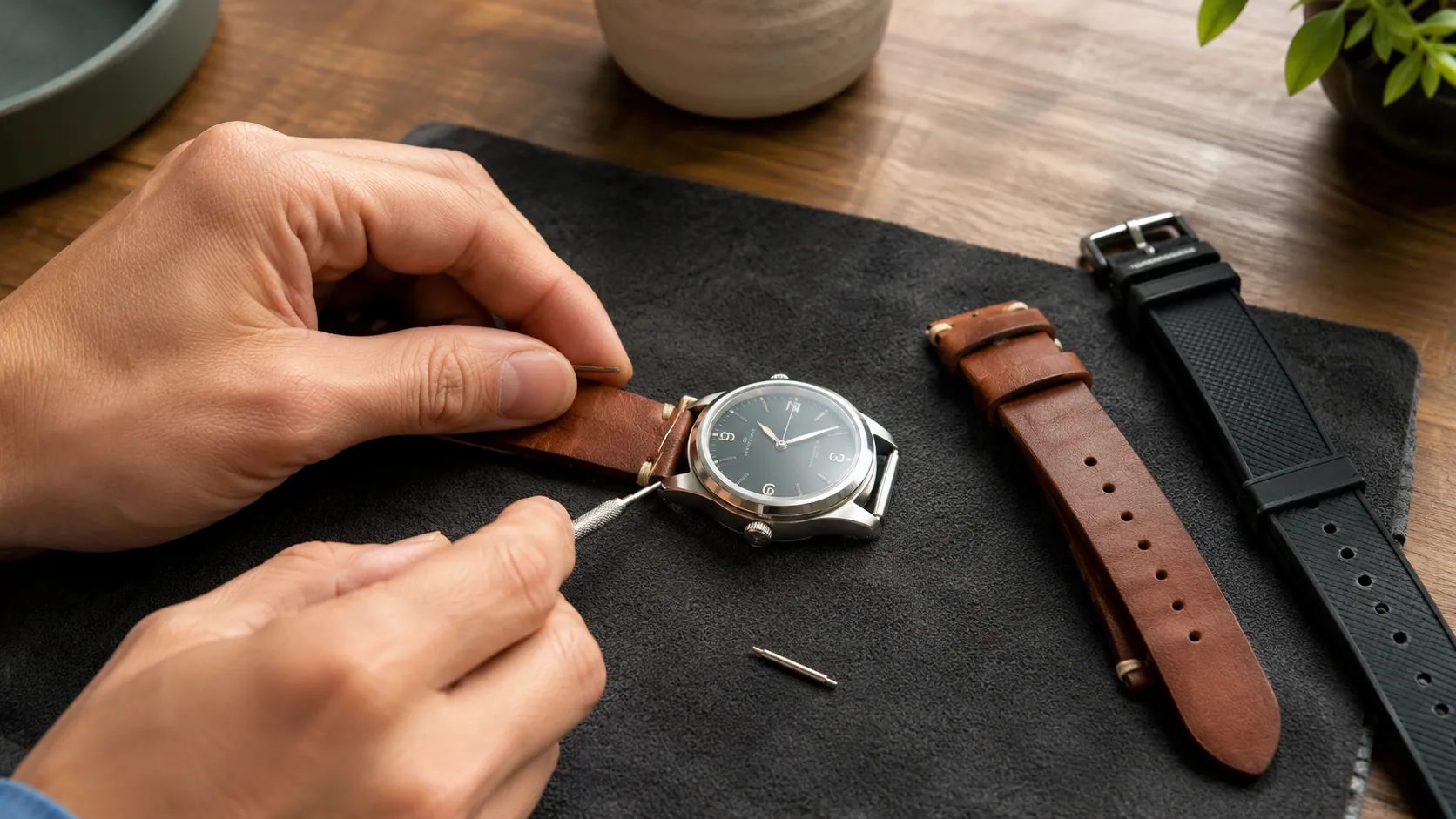
How to change the strap on a watch is easier than most people think, as long as you know your watch strap type, use the right spring bar tool, and work carefully to avoid scratches. Whether you want to replace a worn leather strap, switch to a rubber strap for summer, install a NATO strap, or refresh your watch with a new metal bracelet, the basic idea is simple: remove the old strap safely, fit the correct replacement strap, and check that everything is secure before wearing it.
A good watch strap replacement can completely change the look, comfort, and purpose of your watch. A dress watch can feel more casual with a nylon strap, a sports watch can feel more practical with silicone, and an old watch can look almost new with fresh leather. This guide explains how to change a watch strap at home, what tools you need, how to measure lug width, and when it is better to visit a jeweler or watchmaker.
Before You Start: Check Strap Type, Lug Width, and Fit
Before removing anything, check what kind of strap system your watch uses. Not every watch band attaches the same way. Many traditional watches use spring bars, which are small metal pins that sit between the watch lugs. Some watches use quick-release spring bars, screw pins, steel pins, drilled lugs, or a fitted metal bracelet with end links. Smartwatches may use brand-specific connectors instead of normal spring bars.
The most important measurement is lug width, which is the distance between the lugs where the strap connects to the watch case. Common sizes include 18 mm, 20 mm, and 22 mm, but you should always measure your own watch instead of guessing. A 20mm strap usually will not fit properly into a 22mm lug width, and a strap that is too wide may scratch the case or refuse to seat correctly.
You can measure lug width with a digital caliper or a ruler marked in millimeters. Also check the strap thickness, buckle width, and whether your watch needs straight or curved spring bars. This simple watch strap compatibility guide step prevents one of the most common problems: buying a replacement strap that looks right online but does not actually fit the watch.
Tools You Need to Change a Watch Strap
The right tools make watch strap replacement safer and easier. For most watches, the most useful tool is a spring bar tool. It usually has a forked end or V-shaped end that helps compress the spring bar shoulder without damaging the lugs. A basic watch strap removal tool is inexpensive and much safer than using a knife.
You should also prepare a soft cloth, microfiber cloth, or padded mat. Place the watch face down on the cloth to protect the crystal and case. If your watch is expensive or polished, use painter’s tape or masking tape around the lugs to reduce the chance of scratches. A small screwdriver may be needed for screw pins, while tweezers can help handle small spring bars.
| Tool | Best Used For | Beginner Tip |
| Spring bar tool | Removing and installing spring bars | Best tool for most traditional watches |
| Microfiber cloth | Protecting the watch face | Always work on a soft surface |
| Painter’s tape | Protecting the lugs | Helpful for polished or luxury cases |
| Small screwdriver | Screw pins or some bracelets | Use the exact size to avoid slipping |
| Digital caliper or ruler | Measuring lug width | Measure in millimeters |
If you do not have a spring bar tool, some people use a small screwdriver, but this increases the risk of slipping and scratching the case. For beginners, a proper strap changing tool is worth it.
How to Remove the Old Watch Strap
To remove the old watch strap, start by setting up a clean, stable workspace. Lay a soft cloth on a table and place the watch face down. Make sure there is good lighting because the spring bar shoulders, spring bar flanges, and lug holes can be small and hard to see.
Look between the strap and the lugs. On a traditional two-piece strap, the spring bar runs through the end of the strap and snaps into holes inside the lugs. Insert the forked end of the spring bar tool between the strap and the lug. Gently press inward to compress the spring-loaded pin. Once one end of the spring bar leaves the lug hole, carefully move the strap away from the case.
Do not force the strap. If the spring bar does not move, adjust the angle and try again with gentle pressure. A spring bar can fly out if you push too hard, so keep your other hand close and work over the cloth. Repeat the same process on the other side of the watch.
Here is the simple removal flow:
- Place the watch face down on a soft cloth.
- Find the spring bar shoulder near the lug.
- Press the spring bar inward with the tool.
- Pull the old strap away from the lug.
- Repeat on the second strap piece.
If you are removing a very old strap, inspect the spring bars. If they are rusty, bent, weak, or loose, replace them instead of reusing them.
How to Install the New Watch Strap
Once the old strap is removed, check that your new watch strap matches the correct lug width. Insert the spring bars through the holes at the end of the replacement strap. If the spring bars feel loose inside the strap, they may be the wrong size or worn out.
Next, place the strap in the correct orientation. On most traditional watches, the buckle side goes on the 12 o’clock side, and the longer tail end goes on the 6 o’clock side. This placement helps the watch buckle naturally around your wrist. Installing the strap upside down will not usually damage the watch, but it can feel awkward and look wrong.
To install the strap, place one end of the spring bar into the first lug hole. Then use the spring bar tool to compress the other end and guide it between the lugs. Move the strap slowly until the spring bar snaps into the second lug hole. You may hear or feel a small click when it seats properly.
After installation, do a safety check. Gently pull the strap away from the case. It should not pop out, shift, or rattle. Look closely at both sides to confirm the spring bar is seated in the lug holes. This is one of the most important steps in how to secure spring bars into the lugs, because a loose spring bar can cause the watch to fall off your wrist.
How to Change a Quick-Release Watch Strap
Quick-release straps are easier than standard straps because they have a small lever on the back of the strap. Instead of using a spring bar tool, you slide the lever inward to compress the quick-release spring bar. This makes them ideal for beginners and people who like to switch between leather, rubber, and nylon straps often.
To remove a quick-release strap, turn the watch over, slide the small lever inward, and gently pull the strap away from the lugs. To install the new quick-release strap, place one end of the spring bar into the lug hole, slide the lever inward, align the other end, and release the lever when it is in place.
Quick-release straps are convenient, but they are not universal. You still need the correct lug width, and some watch cases do not have enough clearance for thick quick-release straps. Always test the strap before wearing the watch outside.
How to Change a NATO or Slip-Thru Watch Strap
A NATO strap or Slip-Thru strap works differently from a two-piece leather or rubber strap. It is usually a one-piece NATO strap that passes behind the watch case and through the spring bars. In many cases, you do not need to remove the spring bars at all.
To install one, thread the long end of the strap through the top lug, pass it behind the watch case, and pull it through the bottom lug. Then pass the strap through the metal keepers and adjust it so the watch sits centered on the wrist. The spring bars stay in place and act like anchors.
NATO straps are popular because they are casual, affordable, and secure. If one spring bar fails, the second spring bar may still help hold the watch on the strap. They are especially useful for field watches, outdoor watches, and summer wear.
How to Change a Metal Bracelet or Mesh Strap
Changing a metal bracelet can be more difficult than replacing a leather strap. Metal bracelets often have end links, tight tolerances, and small cut-away slots where the spring bar tool must fit. A mesh bracelet may be easier, but fitted steel bracelets can be tricky.
To remove a metal bracelet, place the watch face down on a padded mat. Use the forked end of the spring bar tool to compress one side of the spring bar through the cut-away slot near the end link. Once one end releases, gently pull the bracelet away from the case. Repeat on the other side.
Do not force a bracelet if it feels stuck. A stubborn bracelet spring bar can scratch the lugs or bend the end link if handled roughly. If the bracelet uses screws, a fold-over clasp, butterfly clasp, or fitted end links, take extra care. For expensive watches, vintage watches, or tight bracelets, professional help from a watchmaker is often the safer choice.
How to Change a Smartwatch Strap
Smartwatches often use a different strap system from traditional watches. An Apple Watch uses a band release button that lets the strap slide out of the case. Some Samsung Galaxy Watch models use quick-release pins similar to traditional watches. Some Garmin models use a Garmin QuickFit strap, where the strap clips into place without a standard spring bar tool.
Because smartwatch systems vary, always check the model before buying a replacement band. A strap made for one Apple Watch case size may not fit another size. A Samsung or Garmin strap may need the correct lug width, quick-release pin size, or proprietary adapter.
The basic rule is simple: do not force a smartwatch strap. If it does not slide, click, or seat smoothly, stop and check the manufacturer’s instructions. Forcing a proprietary connector can damage the watch case or locking mechanism.
How to Avoid Scratches and Watch Case Damage
The biggest fear beginners have is scratching the watch. The safest way to change a strap is to prepare the workspace before touching the spring bars. Place the watch on a soft surface, use a microfiber cloth, and tape the lugs if the case has polished sides.
When using a spring bar tool, keep the tool angled toward the strap, not toward the outside of the lug. This reduces the chance of the tool slipping across the case. Use controlled pressure instead of force. If the spring bar will not compress, pause and reposition the tool.
For luxury watches, vintage watches, or watches with sentimental value, it may be worth paying a professional. A strap change is usually simple, but one deep scratch on a polished lug can be more frustrating than the cost of a jeweler.
As the saying goes, “Measure twice, cut once.” For watches, a better version is: measure the lug width twice, press the spring bar once, and never force the fit.
Troubleshooting: What If the Strap Does Not Fit or Feels Loose?
Sometimes a new strap does not fit even when it looks correct. The most common reason is the wrong lug width. If your watch needs a 20mm strap and you bought a 22mm strap, it may be too wide to fit between the lugs. If you bought an 18mm strap for a 20mm lug width, it may leave gaps and feel loose.
Another common issue is a spring bar that is not fully seated. If the strap feels loose after replacement, remove it and reinstall it carefully. Make sure both ends of the spring bar click into the lug holes. If the spring bar is bent, rusty, or weak, replace it.
| Problem | Likely Cause | What to Do |
| Strap does not fit | Wrong lug width or strap thickness | Re-measure the distance between the lugs |
| Strap feels loose | Spring bar not seated | Reinstall and test both ends |
| Spring bar flies out | Too much pressure or poor angle | Work slowly over a cloth |
| Spring bar is stuck | Dirt, corrosion, or tight fit | Use proper tool or visit a jeweler |
| Lugs get scratched | Tool slipped | Use tape and gentle pressure |
If you keep asking, “Why won’t my new watch strap fit?” check lug width, strap thickness, spring bar length, and case shape before blaming the strap.
Choosing the Right Replacement Strap
A good replacement watch strap buying guide should start with fit, then material. Once you know the correct size, choose a strap based on how you wear the watch.
| Strap Material | Best For | Watch Style |
| Leather strap | Formal outfits and office wear | Dress watches, classic watches |
| Rubber strap | Water, sweat, and sports | Dive watches, outdoor watches |
| Silicone strap | Comfort and fitness | Smartwatches, casual watches |
| Nylon / NATO strap | Summer and everyday casual wear | Field watches, military-style watches |
| Metal bracelet | Durability and long-term use | Sports watches, dress-sport watches |
| Mesh bracelet | Lightweight metal look | Casual and dress watches |
A leather vs rubber watch strap choice depends on lifestyle. Leather looks refined but does not love sweat or water. Rubber and silicone are better for workouts, humidity, and summer. A NATO vs leather watch strap decision is more about style and comfort: NATO is casual and washable, while leather feels more formal.
Also consider hypoallergenic straps, vegan leather straps, water-resistant options, buckle style, strap taper, and thickness. A thick padded leather strap may look great but may not fit under tight lugs.
DIY vs Professional Watch Strap Replacement
DIY strap replacement is usually fine if your watch uses standard spring bars, you have the correct strap size, and you are comfortable using a spring bar tool. It is also a good option for affordable watches, casual watches, and quick-release straps.
Professional service is better when the watch is expensive, vintage, or difficult to replace. If the spring bars are stuck, screws are stripped, end links are tight, or the watch warranty could be affected, visit a local jeweler, watchmaker, authorized service center, or professional watch technician.
The watch strap replacement cost is often low compared with the cost of repairing a scratched luxury case. If you are unsure, paying a professional is the safer choice.
Quick Watch Strap Replacement Checklist
Use this quick checklist before wearing the watch:
- Measure the lug width in millimeters.
- Choose the correct replacement strap type.
- Prepare a spring bar tool, cloth, and tape if needed.
- Remove the old strap slowly.
- Place the buckle side on the 12 o’clock side.
- Seat both spring bars fully into the lug holes.
- Gently pull the strap to test for a secure fit.
- Check that the strap is straight, comfortable, and not loose.
This simple watch strap installation checklist can prevent most beginner mistakes.
FAQs About Changing a Watch Strap
Can I change a watch strap myself?
Yes, you can change a watch strap yourself if the watch uses standard spring bars, quick-release pins, or a simple NATO-style setup. Use the right tool, work on a soft cloth, and avoid forcing the strap. If the watch is luxury, vintage, or difficult to handle, a jeweler may be safer.
Do I need a spring bar tool?
For most traditional watches, a spring bar tool is the best tool to use. Some quick-release straps do not need tools, and some screw-pin straps need a small screwdriver. A screwdriver can work as a spring bar tool alternative, but it is more likely to slip and scratch the lugs.
How do I know what size watch strap I need?
Measure the lug width, which is the space between the lugs where the strap attaches. Common sizes are 18 mm, 20 mm, and 22 mm. The strap width must match the lug width. If your watch has a 20mm lug width, buy a 20mm strap.
Which side does the buckle go on?
On most watches, the buckle side goes on the 12 o’clock side, while the longer tail end goes on the 6 o’clock side. This helps the buckle sit naturally under the wrist.
Why does my new watch strap not fit?
Your new strap may not fit because the lug width is wrong, the strap is too thick, the spring bars are the wrong size, or the watch case has an unusual shape. Re-measure the distance between the lugs and check compatibility before forcing the strap.
When should I replace spring bars?
Replace spring bars if they are bent, rusty, weak, loose, or no longer snap firmly into the lug holes. Spring bars are small, but they hold the entire watch on your wrist, so they should be secure.
Should I take my watch to a jeweler?
Take your watch to a jeweler or watchmaker if the bracelet is stuck, the spring bar will not release, the watch is expensive, or you are worried about damaging the case. Professional strap replacement is often worth it for luxury watches.
Conclusion: Change Your Watch Strap Safely and Confidently
Learning how to change the strap on a watch gives you more control over the style, comfort, and daily use of your watch. The key is to measure the lug width, use the right spring bar tool, protect the case from scratches, and test the new replacement strap before wearing it. Most simple strap changes can be done at home, especially with leather, rubber, silicone, NATO, and quick-release straps. But if your watch has a difficult metal bracelet, stuck spring bars, or high value, a professional watchmaker or jeweler is the safest option.
Disclaimer: This article is for general informational and educational purposes only and does not constitute professional watchmaking, repair, jewelry, or technical advice. Watch strap systems, spring bars, connectors, and installation methods vary by brand and model. Always use appropriate tools, follow manufacturer guidelines, and consult a qualified watchmaker or jeweler if you are unsure about replacing a strap.














Leave a Reply