

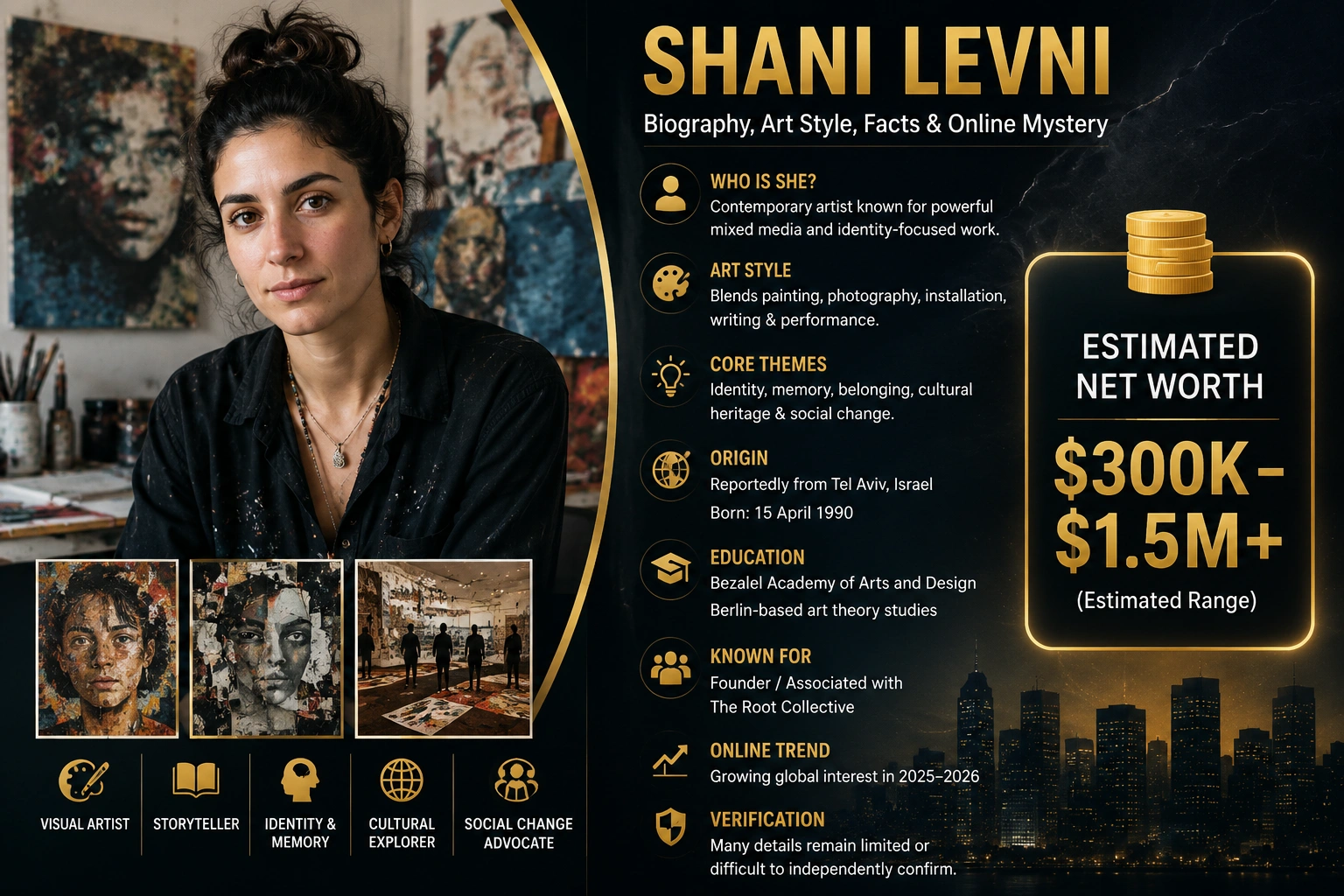
Shani Levni is a name that has recently started appearing across online art profiles, biography-style articles, and creative culture discussions. Many readers search for Shani Levni because they want a simple answer: Who is Shani Levni, what is she known for, and why is her name gaining attention in 2026?
The short answer is that Shani Levni is generally described online as a contemporary artist, mixed media creator, writer, and cultural thinker whose work is often linked with identity, memory, belonging, social change, and emotional storytelling. However, the longer answer is more interesting. Public information about her remains limited, and many details found online appear to be repeated across different websites without strong primary-source confirmation.
That makes Shani Levni biography searches different from ordinary celebrity or artist profiles. Instead of treating every claim as proven fact, this article takes a balanced approach. It explains what is commonly reported, what themes appear across online profiles, what remains unclear, and why the Shani Levni online mystery has become part of the search interest around her name.
Who Is Shani Levni?
Shani Levni is commonly presented as a multidisciplinary contemporary artist whose creative work blends visual art, mixed media, performance, writing, installation art, and social advocacy. Across competitor profiles and online discussions, she is described as an emerging artist with a strong interest in memory, identity, cultural heritage, emotional depth, and community engagement.
In simple words, Shani Levni is portrayed as a modern creative figure whose work is not limited to painting or gallery-based art. Her name is often connected with contemporary visual storytelling, meaning art that communicates ideas, emotions, cultural questions, and personal experiences through images, materials, symbols, and space.
What makes her profile unusual is the combination of two things. First, many articles describe her as a powerful creative voice. Second, verified public documentation about her career, exhibitions, education, and personal background appears limited. This contrast has made users ask questions such as “Is Shani Levni a real person?”, “What facts about Shani Levni are verified?”, and “Why is information about Shani Levni unclear?”
For SEO and reader trust, the safest way to understand her is this: Shani Levni is an online art-profile entity associated with contemporary art, mixed media, identity, memory, and social change, but some biography details should be treated as reported rather than fully confirmed.
Quick Facts About Shani Levni
Here is a simple overview of the most commonly repeated information about Shani Levni. Because public records are not fully clear, some details should be read as reported claims, not guaranteed facts.
| Topic | Commonly Reported Information |
| Name | Shani Levni |
| Known for | Contemporary art, mixed media, identity-based work |
| Creative fields | Visual art, painting, photography, installation, writing, performance |
| Core themes | Identity, memory, belonging, cultural heritage, social change |
| Reported birthplace | Tel Aviv, Israel |
| Reported birth date | 15 April 1990 |
| Reported education | Bezalel Academy of Arts and Design, Berlin-based art theory studies |
| Associated project | The Root Collective |
| Search trend | Growing online interest in 2025–2026 |
| Verification status | Many details remain limited or difficult to independently confirm |
This table is useful because many readers want fast facts. Still, the most important point is that Shani Levni verified facts and Shani Levni unverified claims should be separated carefully.
Shani Levni Early Life and Background
Several online profiles report that Shani Levni’s early life and background are connected to Tel Aviv, Israel, a city known for its active creative scene, galleries, cultural diversity, and experimental art communities. Tel Aviv is often described as a place where tradition and innovation meet, which fits the way Shani Levni’s work is commonly interpreted.
Her reported background is often connected with Middle Eastern roots, Israeli cultural influence, multicultural identity, and European creative exposure. These elements matter because they help explain why her work is often discussed through themes like belonging, displacement, diaspora, cultural memory, and identity formation.
In many artist biographies, early life is used to explain the emotional source of the work. For Shani Levni, online descriptions often suggest that her artistic voice grew from a mix of personal history, cultural storytelling, and social awareness. Whether every detail of that background is fully documented or not, these themes are central to how writers and readers understand her profile.
A careful biography should avoid saying too much with certainty. Instead of claiming every detail as fact, it is better to say that Shani Levni is often associated with Tel Aviv, Israel, and with a creative background shaped by culture, memory, and social reflection.
Education and Creative Foundations
Many articles connect Shani Levni education and training with the Bezalel Academy of Arts and Design in Jerusalem and later study or creative development in Berlin. Some sources also mention an MFA in Art Theory, though this is another detail that should be treated with caution unless supported by primary records.
These education-related entities are important for topical relevance because they connect her name with fine arts, philosophy, cultural studies, social sciences, and contemporary art theory. They also help explain why her work is often described as both emotional and intellectual.
A traditional artist might focus mainly on technique, color, or composition. Shani Levni’s reported creative foundation is broader. Her work is usually discussed as a combination of visual language and conceptual thinking. This means the artwork is not only meant to look beautiful; it is meant to make viewers think about identity, memory, trauma, healing, cultural boundaries, and human connection.
If the reported education details are accurate, they would support the idea that Levni’s art comes from both studio practice and critical theory. If they are not fully verified, they still show how online profiles are positioning her: as a cultural thinker as much as a visual artist.
How Shani Levni Started Her Career
The story of how Shani Levni started her career is usually presented as gradual rather than sudden. Competitor profiles describe her as an artist who moved through small venues, community spaces, creative networks, collaborations, workshops, and experimental projects before gaining wider online attention.
This career path fits many modern artists. In the past, recognition often came through formal galleries, museum collections, art schools, and critics. Today, an emerging artist can gain attention through online platforms, digital publications, social media, community projects, and interdisciplinary collaborations.
Shani Levni’s reported career does not appear to follow a simple gallery-only model. Instead, she is described as someone working across painting, photography, performance, writing, installation, and public dialogue. This gives her profile a more flexible, modern shape.
Her creative identity is often built around the idea that art should not remain separate from society. In that sense, Shani Levni career topics overlap with art as activism, art as healing, and art as community engagement.
Shani Levni’s Art Style and Creative Work
One of the strongest competitor-covered topics is Shani Levni art style. Nearly every profile describes her work through the language of mixed media, symbolism, layered textures, emotional depth, and visual storytelling.
Mixed media art means combining different materials or creative methods in one artwork. Instead of using only paint on canvas, a mixed media artist may use fabric, paper, paint, collage, photography, digital elements, text, found objects, or performance-based material. This approach allows the artwork to feel layered, both physically and emotionally.
Shani Levni’s creative work is often described as a balance between abstract and figurative elements. Abstract forms may suggest emotion, memory, or spiritual experience, while figurative elements may hint at the body, human presence, identity, or personal history. This balance helps explain why her work is often called open to interpretation.
Important style-related keywords connected to her work include symbolic imagery, bold palettes, soft colors, negative space, fragmented figures, recurring motifs, textured surfaces, layered compositions, visual narrative, and emotional resonance. These terms help describe the kind of art that does not give viewers a single fixed meaning. Instead, it invites them to pause, reflect, and create their own connection.
A useful way to understand the style is this:
“Shani Levni’s reported art style is less about giving direct answers and more about creating space for memory, identity, and emotion to unfold.”
That is why Shani Levni mixed media art works well as a long-tail keyword. It captures not only the medium but also the deeper meaning behind the creative process.
Main Themes in Shani Levni’s Work
The most repeated themes in discussions of Shani Levni’s work are identity, memory, belonging, displacement, cultural heritage, social justice, and human connection. These are also strong LSI keywords because they support the broader topic of contemporary art.
Identity appears to be the central theme. Her work is often interpreted as exploring how people understand themselves through culture, family, history, society, and personal experience. Identity in this context is not fixed. It is layered, changing, and sometimes fragmented.
Memory is another important concept. In mixed media art, memory can be shown through faded images, overlapping textures, broken forms, handwritten text, or repeated symbols. These visual choices can suggest that memory is not perfect. It is emotional, selective, and shaped by time.
Belonging and displacement also appear frequently. These themes connect with broader conversations about migration, diaspora, home, and cultural identity. Whether the viewer sees personal pain, collective history, or spiritual resilience, the work is usually described as asking deeper questions about where people come from and where they feel they belong.
Another strong theme is social change. Shani Levni is often linked with community engagement, marginalized communities, refugees, immigrants, young creators, public murals, workshops, and art as healing. This makes her profile more than a simple artist biography. It places her inside a wider conversation about art and society.
Major Works, Projects, and Exhibitions
Online profiles often mention Shani Levni major works and exhibitions, including titles such as “Between Earth and Sky” and “A Parallel Universe.” Some articles connect A Parallel Universe with Sputnik Gallery and describe it as an interactive exhibition involving audience participation and reflection.
These project titles are useful NLP entities for SEO, but they should be handled carefully. Because independent documentation is limited, the safest wording is to say that these works are reported in online profiles rather than fully verified as museum-documented exhibitions.
The ideas behind these reported works fit the larger pattern of Levni’s described style. Between Earth and Sky suggests a connection between physical life and spiritual meaning. A Parallel Universe suggests alternate realities, inner worlds, and layered perception. Both titles match recurring themes such as memory, identity, emotional depth, spiritual resonance, and open interpretation.
Whether these projects are fully documented or not, they help show how Shani Levni is positioned online: as a creator interested in interactive experiences, immersive installations, symbolic storytelling, and the relationship between viewer and creator.
The Root Collective and Art as Activism
One of the most important entities connected with Shani Levni is The Root Collective. Online profiles describe it as a nonprofit or community-based initiative that uses creative workshops to support refugees, immigrants, marginalized youth, and people with complex personal stories.
This section is important because it connects Shani Levni The Root Collective with the search intent around art as activism and art as social change. In this model, art is not only something displayed in a gallery. It becomes a tool for storytelling, emotional healing, self-expression, community dialogue, and social empowerment.
The idea is simple but powerful. When people use art to express their memories, fears, identity, or hopes, they can create meaning from difficult experiences. Workshops, public murals, and collaborative installations can help people feel seen and heard.
This is why Shani Levni is often described as more than an artist. She is positioned as a cultural thinker, community advocate, and creative voice using art to build connection. For readers, this is one of the most meaningful parts of her online profile because it shows how creativity can move beyond personal expression and become part of public life.
Digital Presence and Why Shani Levni Became an Online Topic
The rise of Shani Levni is closely tied to the digital era. Many people are not finding her through museum catalogs or traditional art criticism. They are finding her through online publications, biography blogs, search results, social platforms, and repeated artist-profile content.
This matters because the internet has changed how artists become visible. In the past, an artist usually needed gallery representation, institutional recognition, or major press coverage. Today, a name can gain attention through search engines, social media, online magazines, and content networks.
That creates both opportunity and confusion. On one hand, digital platforms allow emerging artists to reach global audiences faster. On the other hand, they can spread unverified information quickly. If one website publishes a biography claim and others repeat it, readers may assume it is proven even when the original source is unclear.
This is one reason users search for Shani Levni Instagram, Shani Levni social media, Shani Levni official website, and Shani Levni verified facts. They are trying to confirm whether the information they see online connects to a real, traceable public identity.
Verified Facts vs Unverified Claims About Shani Levni
A strong article about Shani Levni should clearly separate what is commonly reported from what is fully verified. This is one of the biggest content gaps among competitors.
| Claim | Status | Why It Needs Care |
| Shani Levni is associated with contemporary art | Commonly reported | Repeated across multiple online profiles |
| She works with mixed media | Commonly reported | Fits repeated descriptions of her style |
| She explores identity and memory | Commonly reported | Strong thematic repetition |
| She was born on 15 April 1990 | Reported, not strongly verified | Appears online but needs primary confirmation |
| She is from Tel Aviv, Israel | Reported, not strongly verified | Repeated but should be worded carefully |
| She studied at Bezalel Academy | Reported, not strongly verified | Needs institutional or artist CV confirmation |
| She founded The Root Collective | Reported, not strongly verified | Needs official nonprofit or project record |
| Her works are in major collections | Reported, not strongly verified | Should be confirmed through archive or museum records |
This does not mean the information is false. It means a responsible article should not overstate it. The best approach is to use phrases like “is often described as,” “some sources report,” “online profiles associate her with,” and “public documentation appears limited.”
That kind of wording improves trust and helps the article satisfy E-E-A-T principles: experience, expertise, authority, and trust.
Shani Levni Name Confusion: Shani Levni, Shani Livne, or Shani Livni?
Another important gap is name confusion. Users may search for Shani Levni, Shani Livne, Shani Livni, or Shani-Livne. These spellings look similar, but they may not always refer to the same person or entity.
This matters because search engines can mix results when names are close. A user looking for an artist may see results connected with a place, another person, or a different spelling. For example, Shani Livne may appear in Israeli location-related results, while Shani Levni appears more often in artist biography-style content.
A good article should explain this clearly. Shani Levni vs Shani Livne and Shani Levni vs Shani Livni are useful long-tail keywords because they solve a real user problem: spelling uncertainty.
The safest rule is simple. When researching, check the exact spelling, source type, author, publication date, and whether the page is talking about an artist, a location, or another person.
Is Shani Levni a Real Person or an Online Mystery?
The question “Is Shani Levni real?” appears naturally because her public profile is unusual. Many pages describe her with confidence, yet some details are difficult to confirm through primary sources.
There are several possible explanations. She may be a real emerging artist with limited mainstream documentation. She may be a low-profile creative figure whose work is better known in small circles than in major institutions. Or the name may have become amplified by repeated online content, creating a larger digital footprint than the available public record supports.
This does not make the topic less interesting. In fact, it makes Shani Levni a useful case study in how modern online identity works. In the digital age, a name can become searchable before it becomes fully documented. Biography pages, art blogs, and social mentions can create curiosity even when official records are thin.
For readers, the key takeaway is this: Shani Levni is widely described online as an artist, but careful readers should separate repeated claims from verified facts.
Challenges, Criticism, and Limited Public Documentation
Like many emerging artists, Shani Levni’s profile faces the challenge of visibility. Visibility is not only about being mentioned online. It is also about having clear records in artist CVs, gallery pages, exhibition catalogs, museum archives, interviews, verified social profiles, and official websites.
The criticism around Shani Levni is not mainly about the art itself. It is about documentation. When public information is limited, it becomes harder to measure artistic impact, confirm exhibitions, or understand the full career timeline.
At the same time, ambiguity can become part of the appeal. Contemporary art often values mystery, interpretation, and layered identity. If Levni’s public image feels partly hidden or incomplete, that can make people more curious.
Still, a trust-first article should not turn mystery into misinformation. The better approach is to acknowledge uncertainty while explaining the creative themes that make the name worth searching.
Impact on Modern Creativity and Contemporary Art
The phrase Shani Levni modern creativity works because her online profile reflects many trends in the contemporary art world. Modern creativity is no longer limited to one medium, one gallery, or one audience. Artists today often work across painting, photography, digital formats, installation, performance, writing, public dialogue, and community projects.
Shani Levni’s reported work fits this larger movement. Her art is described as emotionally rich, socially aware, and open to interpretation. These qualities match the current demand for art that feels personal but also connected to wider social questions.
Her impact, at least as presented online, comes from combining aesthetic beauty with cultural meaning. She represents the idea that an artist can be a creator, thinker, activist, storyteller, and community builder at the same time.
For young creators, this is an important model. It shows that art can be more than decoration. It can become a way to ask questions, process memory, challenge boundaries, and create human connection.
Future Potential and What to Watch Next
The future of Shani Levni depends on whether clearer public documentation appears over time. If more official records, interviews, exhibitions, artist statements, or verified social profiles become available, her profile could become easier to understand and more credible.
Readers interested in her work should watch for several things: official exhibition listings, gallery representation, museum or archive records, artist CV updates, verified Instagram or website activity, interviews, public talks, and documentation of The Root Collective.
If those sources grow, Shani Levni may move from an online mystery to a more clearly established figure in the contemporary art world. Until then, her name remains interesting because it sits between art, identity, digital presence, and public curiosity.
FAQs About Shani Levni
Who is Shani Levni?
Shani Levni is generally described online as a contemporary artist, mixed media creator, writer, and cultural thinker associated with themes of identity, memory, belonging, and social change.
What type of art does Shani Levni create?
She is most often linked with mixed media art, including painting, photography, installation, performance, collage, symbolic imagery, layered textures, and visual storytelling.
Is Shani Levni a real person?
Online profiles describe her as a real artist, but public documentation appears limited. A careful answer is that Shani Levni is widely presented as an artist online, while some biography details remain difficult to independently verify.
Where is Shani Levni from?
Many sources report that Shani Levni is connected with Tel Aviv, Israel, but this should be treated as a reported detail unless confirmed by a primary source.
What is Shani Levni’s age?
Some online articles report a birth date of 15 April 1990, which would make her in her mid-thirties in 2026. However, this date should be handled carefully because it is not strongly verified through public primary records.
What is The Root Collective?
The Root Collective is described online as a community-focused art initiative connected with creative workshops, refugees, immigrants, marginalized youth, public murals, storytelling, and emotional healing.
Is Shani Levni the same as Shani Livne or Shani Livni?
Not necessarily. Shani Levni, Shani Livne, and Shani Livni may lead to different search results. Users should check spelling and context carefully.
Why is Shani Levni trending in 2026?
She appears to be gaining search attention because of repeated online artist profiles, curiosity around her identity, and interest in her reported connection to contemporary art, mixed media, social change, and digital-era visibility.
Conclusion: What Makes Shani Levni a Search-Worthy Name
Shani Levni stands out because her name combines creativity, mystery, and modern search curiosity. She is commonly described as a contemporary artist whose work explores identity, memory, belonging, cultural heritage, emotional depth, and social change. At the same time, many details about her biography, education, exhibitions, and public record remain unclear.
That is why the best way to approach Shani Levni biography content is with balance. It should highlight the repeated themes around her work while clearly separating verified information from reported claims.
In the end, Shani Levni is search-worthy not only because of the art connected to her name, but also because her online presence reflects a bigger question: How do artists become known in the digital era when visibility can grow faster than verification?
Disclaimer
This article is for general informational purposes only. The details shared are based on available public information and general research. Individual opinions, interpretations, preferences, and situations may vary.




Leave a Reply