

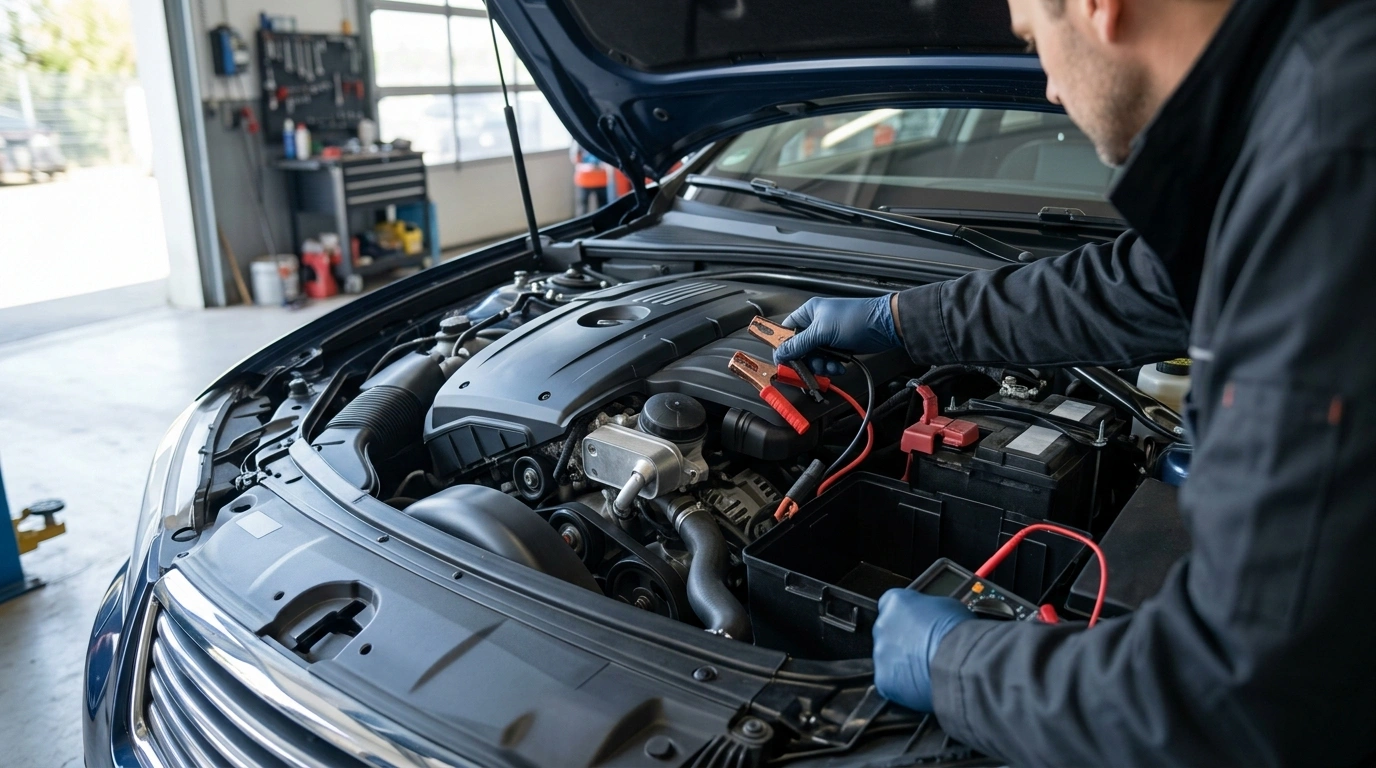
A car can run without battery power in some situations, but the full answer is more complicated than a simple yes or no. In many cases, a vehicle may keep running briefly after it has already started because the alternator is producing electricity, but most modern cars should not be operated without a healthy car battery connected. That is because the battery does more than just start the engine. It also helps stabilize the electrical system, supports the charging system, and protects sensitive electronic components from voltage spikes and unstable system voltage.
If you have ever wondered “will a car run without a battery?”, “can the alternator run the car without the battery?”, or “what happens when battery dies while driving?”, you are not alone. These questions usually come up when a driver is dealing with a dead battery, a weak battery, a bad alternator, or a scary roadside situation where the car suddenly loses electrical power.
This guide explains the real answer in plain English. It also covers battery vs alternator problems, what happens when a battery warning light comes on, whether it is safe to disconnect the battery while the engine is running, and how far you may be able to drive with a charging system failure before the car stalls.
Can a car run without a battery? The real answer
The most accurate answer is this: a car may sometimes keep running without battery support for a short time, but it is not safe, reliable, or recommended, especially in modern vehicle electronics.
In older vehicles with simpler systems, the alternator could sometimes provide enough electrical power to keep the engine going once it had already started. That is why some people still say “yes, a car can run without a battery.” But that old-school answer leaves out an important detail. Today’s vehicles rely on computer controls, ECU and ECM functions, sensors, fuel delivery, ignition timing, lighting, and dozens of accessories that all need stable power. A missing, disconnected, or badly failing battery connected to the system can lead to low voltage, unstable current flow, and in some cases load dump conditions that may harm electronics.
So, can a vehicle run without the battery connected? Sometimes, briefly. Should it? No.
There is also a big difference between these situations:
- A battery is weak but still installed
- A battery is dead but still connected
- A battery terminal is loose or corroded
- The battery is physically removed
- The real problem is a bad alternator rather than the battery itself
Those details matter because the car may behave very differently in each case. That is why online answers can seem contradictory. A driver asking “can a car run without a battery yes or no” is really asking about several different mechanical and electrical situations at once.
What the battery actually does after the engine starts
Many drivers think the car battery only matters for starting the engine, but that is only part of the story. Once the engine is running, the alternator begins generating electricity and recharging the battery. Even then, the battery still plays an important role.
Think of the battery as an electrical storage device, a reserve power source, and a voltage stabilizer. It stores electrical energy, helps smooth out sudden changes in electrical loads, and can act like a kind of surge protector for the vehicle. When the headlights, blower motor, audio system, or power windows suddenly draw more energy, the battery helps absorb and balance those changes.
That is why a healthy battery is not just about cranking the starter motor. It also helps protect the ignition system, fuel system, spark plugs, and electronic control unit from voltage fluctuations, high voltage fluctuations, and voltage spikes. In plain terms, the battery helps the whole electrical system stay calm and consistent.
A simple way to remember it is this:
The alternator makes power, but the battery helps manage it.
That is also why advice like “just disconnect the battery and let the alternator do the work” is outdated on most vehicles. A battery that stores stored power and helps absorb voltage spikes is doing useful work every second the engine is running.
Battery vs alternator: which one keeps the car running?
The battery vs alternator question is one of the most important parts of this topic, and it is where many drivers get confused.
The battery mainly provides the power needed to start the vehicle. The alternator mainly takes over after the engine is running by supplying electricity to the car and recharging the battery. That sounds simple, but real-world problems blur the line.
A car with a weak battery may still start with a jump-start and appear normal for a little while. A car with a bad alternator may also start after a jump, but then quickly lose power again because the battery is no longer being recharged. That is why one of the most useful questions is not just “can a car run without battery?” but “is it the battery or alternator?”
Here are some common clues:
| Symptom | More likely battery | More likely alternator / charging system |
|---|---|---|
| Slow crank in the morning | Yes | Sometimes |
| Car starts after jump-start and stays fine | Yes | Less likely |
| Car starts after jump-start but dies again soon | Sometimes | Yes |
| Battery warning light on dash | Sometimes | Yes |
| Dim headlights or flickering lights while driving | Sometimes | Yes |
| Repeated dead battery even after replacement | Less likely | Yes |
| Car stalls while driving | Less likely | Yes |
A failing charging system can also trigger alternator failure symptoms such as a dashboard battery light, weak accessories, erratic electronics, or the engine shutting off once the remaining battery reserve is gone. On the other hand, a bad battery can also create odd electrical behavior, so the smart approach is to test both.
It is also fair to ask “can a bad alternator drain a battery?” Absolutely. If the alternator is not supplying proper charging voltage, the car keeps pulling energy from the battery until there is not enough left to run the engine and electronics. And yes, in some cases, a damaged battery can also put stress on the charging system.
What happens if the battery dies while driving?
When people search “what happens when battery dies while driving”, they are usually worried about being stranded, and for good reason.
If the battery becomes severely depleted while the vehicle is moving, the first signs are often electrical. You may notice a battery warning light, dim headlights, flickering lights, weak power windows, radio issues, or reduced blower motor speed. As the system voltage drops, the car’s computers, ignition, fuel system, and accessories may stop working correctly.
If the alternator is healthy, the car may continue to run for a while because the charging system is still supplying energy. But if the alternator is weak, damaged, or not charging at all, the battery becomes the car’s only remaining reserve. Once that reserve is empty, the vehicle may stall while driving.
That can also affect systems the driver takes for granted. You may experience loss of electrical power, dashboard warnings, or difficulty with electronically assisted features. In some vehicles, even if the engine still runs, performance can become unstable because the computer controls are not getting the voltage they expect.
So, while a battery dying on the road does not always mean an immediate shutdown, it is never something to ignore. It usually points to a larger charging system failure, poor battery condition, or a bad connection such as battery terminal corrosion, loose battery terminals, or a disconnected battery terminal.
Is it safe to disconnect the battery while the engine is running?
In one word: no.
Years ago, some mechanics and DIY drivers used battery disconnection as a rough alternator test. The idea was simple: if the engine stayed running, the alternator must be good. On a modern car, that is a risky move.
Why? Because the battery is not just a passive box sitting under the hood. It acts as a stabilizer for the charging voltage. If you remove that buffer while the engine is running, you can create unstable current flow, voltage spikes, and even a load dump event. Those sudden surges can damage sensitive electronics, including the ECU, ECM, infotainment modules, charging controls, and other electronic components.
That means the old question “is it safe to remove battery terminal to test alternator?” has a modern answer: do not do it. The same goes for “should you disconnect a car battery while running?”
A better and safer method is to use a multimeter and check system voltage properly. That gives you real information without risking the very components you are trying to protect.
Can you start a car without a battery? It depends on the situation
This part often gets mixed up with the main keyword, but starting a car and running a car are not the same thing.
If the battery is merely weak or dead but still installed, a jump-start may get the engine running. If the battery is completely missing, the answer becomes much less practical. Most vehicles need some form of electrical input to activate the starter motor, ignition system, fuel delivery, and electronics. That is why the idea of “how to start your car without a battery” is often misunderstood.
A few scenarios matter here:
- Weak battery still installed
A jump-start using jumper cables or a booster pack may work well.
- Dead battery still installed
The car may still start with external power, but if the battery is severely damaged internally, even that may not help much.
- Battery completely removed
This is where things get difficult. Many vehicles will not start properly at all without some stable electrical source in the system.
- Manual transmission vehicle
Some older manual transmission cars may be push-started under the right conditions.
- Automatic transmission vehicle
A typical automatic vehicle usually cannot be push-started.
- Diesel vehicle
A diesel vehicle may behave differently, but it still relies on electrical support for control systems and starting functions.
So, can a car get started without a battery? Sometimes, with help and under very specific conditions. But can I manually start my car without a battery? For most modern drivers, that is not a reliable plan.
Push-start, tow-start, and jump-start: what actually works
This is where a lot of online advice gets messy.
A jump-start is the most common and useful method if the battery is weak or discharged. It supplies an external power source so the car can crank and start. But it is not a cure. It only gets the system going if the underlying problem is temporary or manageable.
A push-start can work on some older or simpler manual transmission cars. The vehicle is rolled, the clutch is engaged, and engine movement may help it fire up. But this depends on design, condition, and whether enough electrical support exists for ignition and fuel delivery. Many newer cars will still struggle.
A tow-start is similar in concept but even less practical and usually not advisable for normal drivers. It brings extra risk and is rarely a smart roadside choice today.
As for automatic transmission vehicles, the answer is usually no. They are generally not candidates for push-starting. That is why the long-tail question “can you push-start an automatic vehicle without a battery?” usually ends in disappointment.
Some sources mention figures like 10 to 15 volts or talk about alternator excitation, where the alternator needs a certain amount of initial power to begin charging properly. That is another reason a vehicle with no meaningful battery support may not behave as people expect.
Signs it’s the charging system, not just the battery
If your car starts with a jump and then dies again, the real issue may not be the battery at all. It may be the charging system.
Common signs of a bad alternator include:
- A glowing battery warning light
- Dim headlights
- Flickering lights
- Weak power accessories
- Electrical glitches
- Repeated dead batteries
- A car that stalls shortly after a jump-start
These alternator failure symptoms matter because they help answer one of the biggest user pain points behind this keyword. A lot of people think “my battery died” when the real problem is “my alternator stopped charging.”
In simple terms, if the battery is just worn out, a jump-start may help and the car may continue running normally after recharge. If the alternator is failing, the jump-start only buys time. The vehicle runs off the remaining battery reserve and then quits again. That is why car stalls after jump-start is such an important clue.
How far can you drive with a bad alternator or failing battery?
There is no single answer, and anyone promising an exact distance is guessing.
A car with a bad alternator may only run for a short time, or it may keep going for longer if the battery is fully charged and the electrical load is light. Turn on the headlights, cabin fan, rear defroster, heated seats, and infotainment, and that reserve will disappear faster.
The same is true if the battery itself is failing. A weak battery may still support the vehicle for a while, but once system voltage drops too low, the engine and electronics can no longer operate correctly.
So if you are asking “how long can a car run with a bad alternator?” or “how far can you drive with a bad alternator?”, the safest answer is: only as long as the remaining stored power lasts, and that may not be long enough to risk it.
If the car is showing battery warning light, flickering lights, or loss of power steering and electrical functions, treat it like a roadside problem, not a “drive it and see” problem.
How to test the battery and alternator safely
The safest way to check the system is with a multimeter.
With the engine off, a healthy battery often reads around 12.4 to 12.6 volts. If the reading is much lower, the battery may be discharged or weak. Some sources mention 11.5 volts as a sign of a deeply discharged battery.
With the engine running, the system should usually read in a higher charging range. If charging voltage is too low, the alternator may not be doing its job. If the number is too high, the voltage regulator may be overcharging, which can also damage the battery and electronics.
Here is a simple reference table:
| Test condition | Typical meaning |
|---|---|
| 12.4 to 12.6 volts with engine off | Battery is likely charged |
| Around 11.5 volts with engine off | Battery likely weak or discharged |
| Around 13.5 to 14.5 volts running | Charging system likely working |
| Above roughly 15 volts running | Possible voltage regulator issue |
These are general ranges, not a substitute for manufacturer specs, but they are far safer and more useful than pulling off a battery cable while the engine runs.
After a jump-start: can you keep driving?
Yes, sometimes — but it depends on why the car needed the jump.
If the battery simply went low because the lights were left on, driving afterward may help recharge it. Many drivers are told to let the car run or drive for 15 minutes to 30 minutes after a jump. That may help restore some charge, but it does not guarantee the battery is healthy.
If the battery is old, sulfated, or damaged, the charge may not hold. If the alternator is the real problem, the car may die again very quickly. That is why the question “can you drive after a jump-start?” should always lead to another question: “what caused the no-start in the first place?”
A good rule is simple. If the car runs normally afterward and starts again later, the battery may just have needed recharge. If it dies soon after or struggles again, you likely have a bigger issue such as alternator replacement, replace a car battery, or bad battery connections.
Seasonal causes: why batteries fail more in summer and winter
Battery trouble is not random. It often follows the weather.
Hot weather battery damage is a real problem because summer heat speeds up internal battery wear and fluid loss. Then winter arrives, and the same battery suddenly cannot crank the engine well in the cold. That is why drivers often assume cold weather battery problems are caused only by winter, when the damage may actually have started in summer.
Short trips, long parking periods, and parasitic drain can make the situation worse. A parked car battery drain problem is especially common when a vehicle sits for days or weeks without being driven. That is why summer battery failure and winter battery failure often show up around travel seasons, inactive cars, or older batteries.
In other words, if your battery keeps failing, climate and driving habits may be part of the story.
Quick answer table: common scenarios and what they mean
| Scenario | Will the car run? | Main risk | What to do next |
|---|---|---|---|
| Dead battery still installed | Maybe, after a jump-start | May die again | Test battery and alternator |
| Battery disconnected while running | Sometimes briefly | Voltage spikes, electronics risk | Reconnect safely, test system |
| Bad alternator | Only until reserve power is gone | Stalling while driving | Diagnose charging system |
| Weak battery after jump-start | Maybe for a while | No-start returns | Recharge and retest |
| Manual transmission push-start attempt | Sometimes | Not reliable on modern cars | Use proper external power |
| Automatic vehicle with dead battery | Usually not by push-start | Wasted effort, delay | Jump-start or repair |
FAQ
Can a car start without a battery at all?
Usually no, at least not in a practical everyday sense. Most cars need battery support for the starter motor, electronics, and ignition.
Will a car keep running if the battery is disconnected?
It may keep running briefly, but that does not make it safe. Modern cars need stable voltage, and disconnecting the battery can be risky.
Can the alternator power the car by itself?
The alternator supplies electricity once the engine is running, but the battery still helps stabilize the system. So the alternator is not a perfect stand-alone replacement for the battery.
Can a weak battery cause electrical problems while driving?
Yes. A weak battery can contribute to low voltage, strange electronic behavior, and unreliable starting.
How do I know if it’s the battery or the alternator?
Look for patterns. A battery issue often causes slow cranking and no-starts. An alternator issue often shows battery warning light, flickering lights, repeated dead batteries, or a car that dies after a jump-start.
Is it safe to remove a battery terminal to test the alternator?
No. Use a multimeter instead.
Can an automatic car be push-started?
Usually no. A typical automatic transmission does not work that way.
How long should I let a car run after a jump-start?
Often 15 to 30 minutes helps, but the real answer depends on battery health and whether the charging system is working.
Final takeaway
So, can a car run without battery support? Technically, sometimes for a short time. Practically, it is not something you should count on. A healthy car battery, working alternator, and stable charging system all matter. The battery is not just for starting. It helps protect the entire electrical system, supports stable voltage, and keeps modern electronics working correctly.
If your car has a dead battery, battery warning light, dim headlights, or keeps dying after a jump, do not focus only on whether the car can still run. Focus on why the system is failing. In most cases, that is the question that really saves you time, money, and a roadside breakdown.
Disclaimer: This article is for general automotive and informational purposes only. Vehicle behavior and electrical systems may vary by model and condition. Always consult a qualified mechanic or technician for proper diagnosis and repairs.








Leave a Reply