

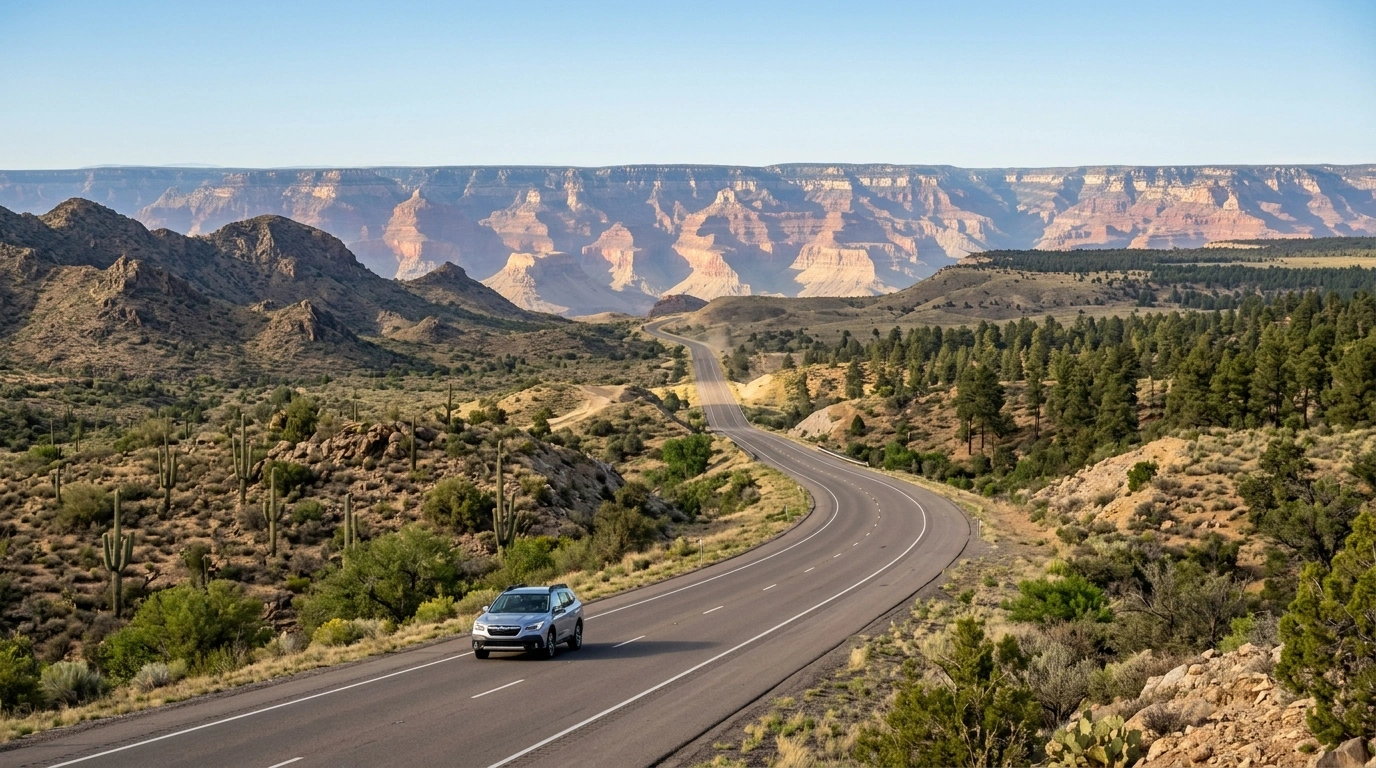
How far is the Grand Canyon from Phoenix depends on which part of the canyon you want to visit, but for most travelers, the answer means the South Rim, which is about 231 miles (372 km) from Phoenix and usually takes around 3.5 to 4 hours to drive under normal conditions. The West Rim is commonly estimated at roughly 4.5 to 5 hours from Phoenix, while the North Rim is much farther and is typically a 6.5- to 7-hour drive depending on conditions and routing.
That simple mileage question turns into a bigger trip-planning decision pretty quickly. Most people also want to know which rim is closest to Phoenix, whether the drive is worth it, if it can be done as a day trip, what the best route is, and what to expect once they arrive. The good news is that a Phoenix to Grand Canyon road trip is very realistic. The better news is that, with the right plan, it can be one of the best Arizona road trip experiences you can take.
Quick Answer: Distance From Phoenix to Each Grand Canyon Rim
The biggest reason travelers get confused is that “Grand Canyon” is not one single destination pin. It includes multiple access areas, and the driving distance changes a lot depending on whether you want the South Rim, West Rim, or North Rim.
| Destination | Approx. Distance From Phoenix | Approx. Drive Time | Best For |
| South Rim | 231 miles / 372 km | 3.5–4 hours | First-time visitors, classic canyon views |
| West Rim | Varies by route | 4.5–5 hours | Skywalk visitors, tour-style trips |
| North Rim | About 350+ miles | 6.5–7 hours | Repeat visitors, quieter scenic experience |
The South Rim is the most popular answer to the question “how far is the Grand Canyon from Phoenix?” because it is the classic Grand Canyon National Park experience, it is open year-round, and it gives you easy access to Grand Canyon Village, major viewpoints, and park services. The West Rim is better known for the Glass Skywalk and is not part of Grand Canyon National Park. The North Rim is beautiful and less crowded, but it is much less practical for a quick trip from Phoenix and has seasonal access limitations.
So if your real question is “which Grand Canyon rim is closest to Phoenix and best for a first visit?”, the answer for most people is still the South Rim, even if the West Rim may sometimes seem competitive depending on the exact starting point and route goals.
How Long Does It Take to Drive From Phoenix to the Grand Canyon?
Mileage alone never tells the full story. A Phoenix to Grand Canyon drive time estimate depends on traffic leaving the city, the route you choose, weather in northern Arizona, construction, and how many stops you make in places like Sedona, Flagstaff, or Williams.
For the South Rim, most travelers should plan on roughly 3.5 to 4 hours of pure driving time. In real life, many trips feel closer to 4.5 hours once you factor in fuel, coffee, bathroom stops, scenic overlooks, and park-entry delays. For the West Rim, many travel guides put the trip around 4.5 to 5 hours. For the North Rim, you are usually looking at the better part of a full travel day each way.
That is why estimated drive time from Phoenix to the Grand Canyon matters more than a raw mileage number. A traveler who only sees 231 miles may assume it is an easy hop, but the trip crosses very different landscapes, elevations, and highway conditions. You start in the Sonoran Desert around Phoenix and head toward much cooler, higher-elevation terrain near Flagstaff and the canyon itself. NPS weather guidance notes that temperatures and conditions can vary sharply by elevation and season, which is especially important in winter driving months and during monsoon season.
Which Grand Canyon Rim Should You Visit From Phoenix?
If you are planning a first visit, this is the real decision point.
The South Rim is the best fit for most travelers because it gives you the classic Grand Canyon National Park experience: iconic overlooks, visitor services, shuttle access, established viewpoints, and easier integration into a Phoenix to Grand Canyon day trip or overnight plan. It is also the area most clearly supported by official NPS directions, fees, hours, and transportation pages.
The West Rim appeals more to travelers who want the Skywalk, packaged tours, or a slightly different experience. It can work for people whose priority is a commercial attraction rather than the classic national park setup. But if someone asks whether the South Rim vs West Rim from Phoenix is the better first-timer choice, the South Rim usually wins on scenery, infrastructure, and overall canyon experience.
The North Rim is stunning, quieter, and often loved by repeat visitors, but it is not the easiest answer to “how far is it from Phoenix to Grand Canyon by car?” because it is much farther, more seasonal, and simply less convenient for most itineraries. NPS hours guidance also distinguishes year-round access at the South Rim / Desert View from the more limited North Rim season.
A helpful rule is this:
- Choose the South Rim for your first trip
- Choose the West Rim for the Skywalk or tour-heavy travel
- Choose the North Rim only if you specifically want a longer, quieter, more specialized trip
Best Route From Phoenix to the Grand Canyon South Rim
For most readers, the best route question really means the best route from Phoenix to the Grand Canyon South Rim.
The standard drive usually heads north from Phoenix on I-17 toward Flagstaff, then connects to I-40 and AZ-64 toward the South Rim. NPS also outlines alternate approaches through Williams, Cameron, and Desert View, with mileage differences depending on which entrance you use. From Williams to Grand Canyon Village is about 59 miles, from Flagstaff through Cameron it is roughly 81 miles / 130 km, and from Flagstaff through Williams the distance is about 63 miles / 101 km plus the remaining segment into the park, depending on approach.
If you want the most efficient trip, the straightforward interstate route is usually best. But if you want a more scenic Phoenix to Grand Canyon road trip itinerary, a detour through Sedona or Oak Creek Canyon can add serious beauty to the drive. That is especially attractive for a weekend getaway or 1–3 day trip rather than a tight one-day dash. Competitor travel guides frequently highlight Sedona, Flagstaff, Williams, and even Route 66 as natural stops because they break up the drive and make the journey feel like part of the vacation, not just transit.
Can You Do the Grand Canyon as a Day Trip From Phoenix?
Yes, you can do the Grand Canyon as a day trip from Phoenix, especially to the South Rim. But whether you should depends on your travel style.
A same-day trip works best if you leave Phoenix early, keep your stops limited, and accept that your time at the canyon will be relatively short. In practice, a South Rim day trip often means 7 to 8 hours of driving total, plus park entry, parking, shuttle or walking time, meals, and viewpoint stops. That makes for a long day, but it is still realistic.
For many travelers, an overnight stay is the sweeter spot. Staying near Grand Canyon Village, Tusayan, or even Williams lets you enjoy sunset, sunrise, or both, instead of just rushing through midday crowds. This also makes it easier to explore more than one overlook, ride the free South Rim shuttle buses, or enjoy a slower scenic drive without constantly watching the clock. NPS notes that parking can become difficult during busy periods, especially by late morning, which is another reason overnight or extra buffer time can improve the experience.
A practical recommendation is this: if your goal is simply to say you have seen the canyon, a day trip works. If your goal is to actually enjoy it, an overnight trip is better.
Best Stops Between Phoenix and the Grand Canyon
A big reason this topic performs well in search is that people are not just looking for mileage. They are planning a trip. That makes best stops between Phoenix and Grand Canyon an important supporting angle.
Sedona is the most obvious crowd-pleaser. Its red-rock scenery, artsy vibe, and access to Oak Creek Canyon make it one of the best stops on a scenic drive north. Flagstaff adds a cooler mountain-town feel, plus access to places like Lowell Observatory and Walnut Canyon National Monument. Williams is a favorite for travelers who want a Route 66 feel or who want to ride the Grand Canyon Railway into the park. Some road-trip itineraries also mention Meteor Crater, Bearizona Wildlife Park, and short scenic food stops in northern Arizona.
These stops are especially useful if you are not trying to force a strict one-day trip. For a 2-day or 3-day outing, they turn the drive into an actual vacation. They also help answer long-tail searches like “best route from Phoenix to Grand Canyon”, “best stops between Phoenix and Grand Canyon”, and “Sedona stop on your Phoenix-based Grand Canyon tour.”
Best Ways to Get From Phoenix to the Grand Canyon Without Driving
Not everyone wants to drive. That is why how to get from Phoenix to the Grand Canyon without a car is such an important subtopic.
One option is to go from Phoenix to Flagstaff by bus, then continue to the canyon by shuttle. Travel resources mention operators such as Greyhound, FlixBus, and Groome Transportation, while tourism-style pages also discuss connecting to the canyon from Williams via the Grand Canyon Railway. Time Out’s route breakdown also covers alternatives like flying part of the way, helicopter tours, and mixed transit options.
The Grand Canyon Railway is one of the most memorable alternatives. It departs from Williams and is often paired with overnight stays or scenic northern Arizona itineraries. If you want the feel of a classic trip rather than a pure point-to-point transfer, this option stands out. Some tour providers also bundle transportation, sightseeing, and attraction access, which appeals to travelers searching vacation packages, tours and lodging, or Phoenix-based Grand Canyon tours.
This is also where commercial intent becomes clear. Many users start with “how far is the Grand Canyon from Phoenix” but are really deciding whether to rent a car, book a shuttle, take a train, or buy a guided tour.
What It Costs to Visit the Grand Canyon From Phoenix
This is one of the most overlooked but useful parts of the whole topic.
According to the National Park Service, the current Grand Canyon National Park entrance fee is $35.00 per private vehicle, $30.00 per motorcycle, or $20.00 per person if entering on foot or by bicycle. These passes are generally valid for 7 days. There is also a Grand Canyon Annual Pass for $70.00 and the America the Beautiful Annual Pass for $80.00.
Those fees matter because many competitor articles talk about the drive but skip the arrival costs. For travelers budgeting a family road trip from Phoenix to Grand Canyon, entrance fees, fuel, food, parking strategy, lodging, and optional tours all shape the real cost. If you are comparing the do-it-yourself drive against commercial tours, this section helps readers make a smarter choice.
Parking, Shuttle Buses, and What to Know Once You Arrive
Once you reach the South Rim, the trip is not over. In many ways, this is where good planning matters most.
NPS advises that parking lots near the visitor center can fill by late morning during busy periods like spring break, summer, and holiday weekends. The park recommends using designated lots and taking the free shuttle buses when needed. The shuttle system includes seasonal and route-based options, and some services vary during the year. NPS also provides detailed parking-lot guidance and notes that traffic congestion is a normal issue at peak times.
This is a major user pain point that many competitors barely cover. Someone asking “how far is the Grand Canyon from Phoenix?” may also need to know that arriving too late can mean extra walking, shuttle dependence, or more time spent circling for parking. That is why Grand Canyon parking and shuttle tips are excellent gap keywords to include naturally in the article.
Best Time of Year to Visit the Grand Canyon From Phoenix
The best time depends on whether you care most about weather, crowds, or route simplicity.
For many travelers, spring and fall are the sweet spots. The weather is usually more comfortable, and the drive feels less punishing than in peak summer heat. NPS weather guidance stresses that canyon conditions vary sharply by elevation and that seasonal changes can be dramatic. Summer brings larger crowds and dangerous heat, especially below the rim. The NPS safety page warns that inner canyon temperatures can exceed 100°F, and summer thunderstorms can create lightning and flash-flood risks.
Winter can be beautiful, but it comes with more uncertainty. Roads to the South Rim remain available year-round, yet snow and ice can affect driving conditions in northern Arizona. That makes current Grand Canyon road conditions and same-day weather checks especially important if you are traveling from Phoenix in colder months.
Before You Go: Hours, Closures, and Smart Trip Planning
This is where official planning beats generic travel content.
NPS states that the South Rim and Desert View are open 24 hours a day, 365 days a year, although some visitor services, facilities, roads, and seasonal operations can vary. The park also maintains pages for what is open and closed, fees, parking, shuttles, and seasonal operations. If you are booking lodging or camping, NPS strongly recommends making reservations in advance, especially during busy travel periods.
That means the smartest version of a Phoenix to Grand Canyon National Park itinerary is not just a map route. It is a checklist:
know your rim, know your route, check weather, verify what is open, budget for the entrance pass, and understand parking before you arrive.
Smart traveler rule: the farther you drive, the more valuable a 5-minute check of official park alerts becomes.
A Simple Planning Example
Here is a practical example for a first-time visitor.
A couple leaves Phoenix at 6:00 a.m., drives the standard route toward the South Rim, stops briefly in Flagstaff for breakfast, reaches the park late morning, uses shuttle access after parking, visits Mather Point and Grand Canyon Village, grabs lunch, watches the afternoon light at another overlook, and drives back in the evening. That is a workable one day Phoenix to Grand Canyon itinerary, but it is a long day with limited flexibility.
Now compare that to leaving Phoenix mid-morning, overnighting in Williams or Tusayan, and entering the park the next day. That version reduces stress, makes sunrise or sunset possible, and gives you more room for scenic stops such as Sedona or Route 66. It also better fits travelers with kids, first-timers, and anyone trying to avoid a rushed experience. The second version is usually the better answer to “is it worth it to drive from Phoenix to Grand Canyon?”
Final Words: Is the Drive From Phoenix to the Grand Canyon Worth It?
Yes, the drive is absolutely worth it for most travelers.
If you want the classic canyon experience, plan around the South Rim, expect about 231 miles and roughly 3.5 to 4 hours of driving from Phoenix, and build in extra time for stops, traffic, and park logistics. The West Rim can suit Skywalk-focused visitors, while the North Rim is better saved for a longer and more specialized trip.
The best version of this article’s answer is not just a number. It is this: the Grand Canyon is close enough to reach from Phoenix, but big enough that planning matters. Choose the right rim, take the right route, and give yourself enough time to enjoy one of the most memorable landscapes in the United States.
Disclaimer: This article is for general travel and informational purposes only. Distances, travel times, and conditions may vary based on route, weather, and traffic. Always check official sources and local updates before planning your trip.







Leave a Reply