

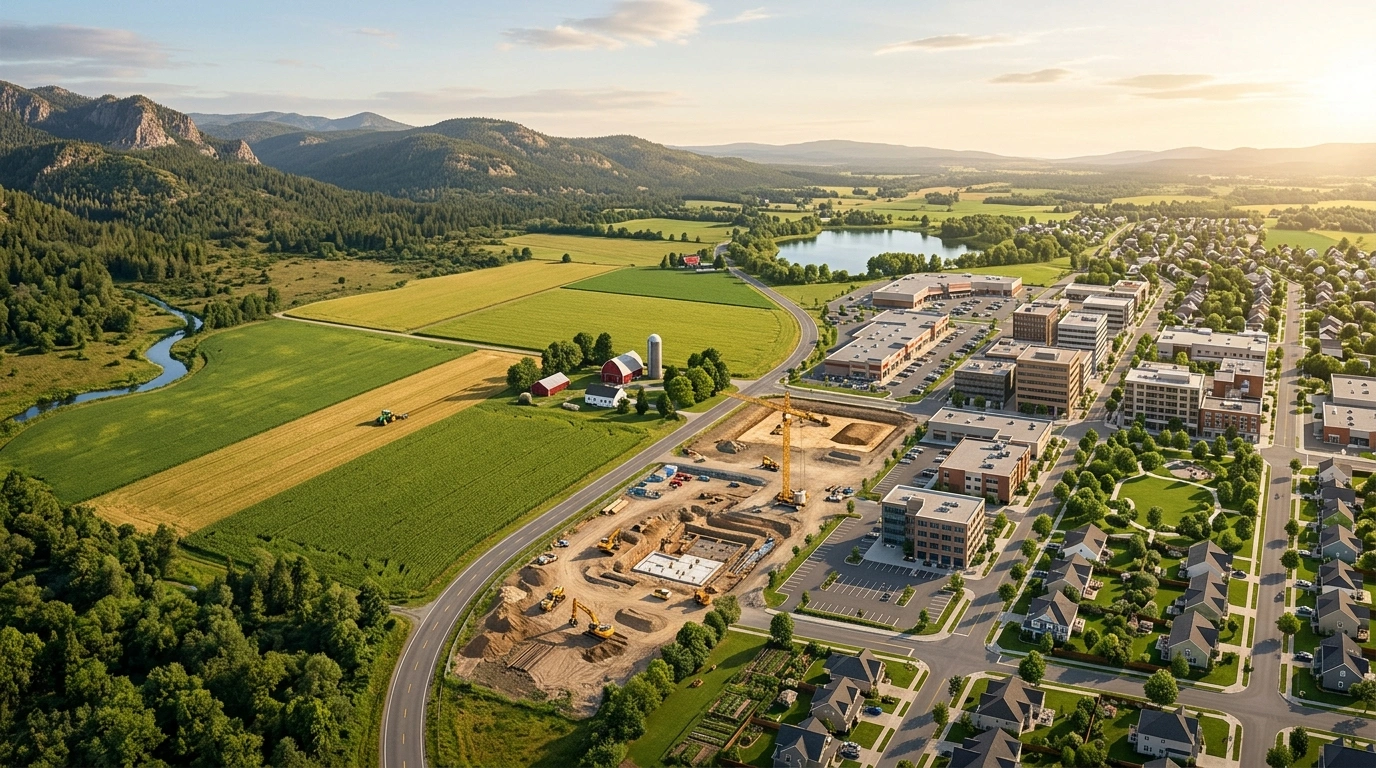
What are the types of land is a simple question, but the answer is broader than most people expect. Land can be classified in several ways, including land use, ownership, development condition, planning status, and even natural or agricultural characteristics. That is why one website may talk about residential land, commercial land, and agricultural land, while another explains state-owned land, common land, brownfield land, or raw land.
If you are a student, buyer, investor, farmer, or just curious about land classification, this guide will make the topic much easier to understand. Instead of giving you one narrow list, this article explains the different types of land through the main systems people actually use in real estate, planning, farming, and property law. It also clears up common confusion around zoning laws, ownership, deeds, parcel terminology, and the difference between buildable and non-buildable land.
By the end, you will understand not only what the major types of land are, but also how to identify land type before buying, which kind is better for building, farming, or investment, and why terms like parcel, tract, section, greenfield land, and Shamilat matter in different contexts.
Why Land Can Be Classified in More Than One Way
One reason people get confused by types of land is that the same piece of land can belong to more than one category at the same time. A property might be privately-owned land, zoned for residential land use, still counted as raw land, and also located in a flood zone or on coastal land. In other words, land does not come with just one label.
The first common system is land use. This focuses on how land is used, such as residential, commercial, industrial, or agricultural land. The second system is ownership, which looks at whether land is private, government-owned, state-owned land, or common land. A third system looks at development condition, which includes raw land, unimproved land, and improved land. Then there is planning and environmental status, where terms like brownfield land, green belt land, greenfield land, and contaminated land appear. Finally, land may be classified by natural features or agricultural suitability, such as forest land, barren land, wetland, pasture, rangeland, or cropland.
This is also where many people mix up zoning vs land use. Land use describes how land is actually used. Zoning laws describe what a local authority legally allows on that land. That difference matters a lot when you want to build, farm, or invest.
Main Types of Land by Use
For most readers, the easiest starting point is types of land by use. This is the most familiar classification and one of the most widely used in real estate and planning.
| Type of land | Main purpose | Typical examples |
|---|---|---|
| Residential land | Housing and living space | House, townhome, condo, apartment building |
| Commercial land | Business activity | Office building, shopping center, restaurant, bar, mall |
| Industrial land | Manufacturing or storage | Factories, warehouses, plants |
| Agricultural land | Farming and food production | Farm, orchard, vineyard, pasture, cropland |
| Mixed-use land | More than one use together | Shops below with apartments above |
| Recreational or special-use land | Leisure, institutions, or public needs | Parks, sports grounds, schools, hospitals |
Residential land
Residential land is meant for homes and living spaces. This includes everything from a single house to a condo, townhome, or a larger apartment building. This type of land is often the easiest for ordinary buyers to understand because it connects directly to housing.
Commercial land
Commercial land is used for business and income-generating activity. A shopping center, retail store, office space, or restaurant usually sits on commercial land. Buyers looking for rental income often pay close attention to this category because land investment potential can be stronger in busy urban areas.
Industrial land
Industrial land is designed for manufacturing, storage, transport, or production. Think of warehouses, factories, or large plants. It often has stricter regulations because of traffic, machinery, noise, and possible environmental concerns.
Agricultural land
Agricultural land is used for farming, livestock, and cultivation. This includes arable land, pasture land, orchards, and crop fields. It may support grazing, cattle breeding, chicken farming, or irrigation-based agriculture.
Mixed-use and special-use land
Some land supports 2 or more types of land uses. For example, a building may have commercial shops downstairs and residential units upstairs. There is also special-use land, such as land for schools, hospitals, government facilities, playgrounds, or religious buildings like mosques.
Types of Land by Development Condition
A major gap in many articles is the difference between raw land, unimproved land, and improved land. These terms are especially important if you are asking, what type of land should I invest in or best type of land for building a house.
Raw land
Raw land is land in its most natural state. It usually has no utilities, no developed road access, and no buildings. It may not have been cleared or surveyed in a way that makes development easy. Raw land is often cheaper, but it can also involve more due diligence.
Unimproved land
Unimproved land is slightly more advanced than raw land, but still lacks some essential features. It may have some access or nearby services, but not enough infrastructure for quick building. Many first-time buyers confuse raw land vs unimproved land, but unimproved land usually has at least some signs of prior planning or accessibility.
Improved land
Improved land has useful additions such as road access, utility lines, drainage, or other infrastructure. If land already has existing infrastructure, it is usually more attractive for development. This is often the better choice for buyers who want buildable land rather than a long-term speculative play.
Buildable vs non-buildable land
Not all empty land can be built on. Non-buildable land may have legal, environmental, access, or soil limitations. For example, land in a protected area, without legal access, or land that fails a percolation test may not support residential development. That is why a cheap plot is not always a good deal.
Types of Land by Ownership and Legal Status
Another very important system is ownership. This is especially relevant in places where property law recognizes different legal categories.
Private land
Privately-owned land belongs to individuals, families, or businesses. Most ordinary real estate transactions involve this category. The owner usually has the strongest control over use, transfer, and sale, subject to law and zoning.
Government or state-owned land
State-owned land or government land belongs to public authorities. It may be used for roads, public buildings, schools, hospitals, parks, or future planning. In some contexts, this is also called Crown land or public land.
Common land and community land
Common land is land shared by a community for communal use. In some regions, it may support grazing grounds, ponds, roads, graveyards, or community buildings. In Pakistan, terms like Shamilat and Shamilat Deh are used for village common property. You may also see the phrase Sarkari Zameen in discussions of state-owned property.
Freehold and leasehold land
A useful legal distinction that many competitors missed is freehold land vs leasehold land. With freehold land, the buyer owns the land itself, usually for an unlimited time. With leasehold land, the buyer has rights for a long period, but not permanent ownership of the underlying land. This can affect resale value, financing, and long-term control.
A simple example helps here. Imagine two similar plots near the same road. One is private freehold land with a clean deed and title history. The other is leasehold, with access rights that expire after a set period. Even if both look identical physically, their legal value can be very different.
Types of Land in Real Estate and Parcel Terminology
Sometimes people searching for types of land really mean land terminology. This is where terms like plot, parcel, tract, and section become important.
Plot, parcel, and tract
A plot is usually a small defined piece of land. A parcel is a legal real-estate unit with a specific boundary and often a parcel number in public records. A tract often refers to a larger area of land.
Plat, block, and section
A plat is a map that shows the division of land into lots, streets, and boundaries. A block is often a group of lots within a subdivision. A section is a land measurement term used in some surveying systems. In the United States, one section is commonly 640 acres, or about one square mile. That is why people often ask, what is a section of land or how much land is a section.
Farm, ranch, and ranchette
A farm is generally land used for growing crops or raising animals. A ranch usually focuses more on grazing or livestock. A ranchette is a smaller version, often part rural lifestyle property and part agricultural land. The difference between a ranch and a farm or a ranch and a ranchette depends on use, size, and local tradition.
Homestead and plantation
A homestead often refers to a home-centered rural property. A plantation usually describes a large agricultural estate devoted to a commercial crop. These terms are not used the same way everywhere, but they still appear in property language and land history.
Types of Land by Planning and Environmental Status
Another useful way to understand land is by its planning condition and environmental history.
Brownfield land
Brownfield land is previously developed land that may now be unused or underused. It can be attractive because it may sit near roads, cities, and utilities. However, it sometimes involves cleanup needs or hazardous substances such as oil, chemicals, asbestos, or other contamination.
Greenfield land
Greenfield land is undeveloped land, often in a rural or open setting. Developers may like it because it is a blank slate, but access, planning permission, and infrastructure can be major hurdles.
Green belt land
Green belt land is usually protected from urban sprawl. In many places, it is tightly controlled to preserve open space, countryside, and environmental balance. People often confuse green belt land vs greenfield land, but they are not the same thing. Greenfield describes undeveloped land, while green belt refers to protected planning policy.
Contaminated land
Contaminated land has environmental problems that may affect safety, health, or construction cost. A smart buyer will check for reports, cleanup obligations, and restrictions before moving forward.
Strategic land
Strategic land is land held for future development potential. Its current use may be agricultural or open space, but investors hope planning policy changes will increase its value over time.
Types of Land by Agriculture and Natural Features
Some people asking about land types are thinking less about real estate and more about the physical nature of land.
Arable land is suitable for crops, while pasture land is more suitable for grazing animals. Forest land supports trees and forestry use. Barren land has little or no productive vegetation. Rangeland is often used for livestock grazing over broad open space. In climate and geography discussions, you may also see desert, grassland, prairie, and steppe.
Then there are land types based on natural form. Mountain land, plain land, plateau land, valley land, and coastal land all have different development, farming, and access characteristics. A wetland may support rich biodiversity but face strict building limits. Fallow land is land left uncultivated for a time to recover fertility. Timberland is managed for wood production, while mineral land may have value tied to extraction rights.
This broader view matters because the best type of land for farming is not the same as the best land for housing or commercial projects.
Land Capability and Agricultural Classification Systems
A more technical but valuable concept is land capability classification. This looks at how suitable land is for farming, irrigation, and long-term conservation. It helps answer questions like whether land is better for crops, grazing, forestry, or limited use only.
In agricultural analysis, factors such as soil quality, slope, erosion risk, water availability, and drainage matter a great deal. More advanced systems also look at soil classification using levels such as Order, Suborder, Great Group, Subgroup, Family, and Series. These numbered stages may sound technical, but the idea is simple: not all agricultural land performs the same way.
For example, two parcels may both look green and open, yet one may be excellent cropland with irrigation potential, while the other works better as pasture because of poor drainage or shallow soil. That is why land suitability analysis, crop selection, crop rotation, and soil conservation measures are important for serious buyers and farmers.
How to Identify What Type of Land a Property Is
If you are planning to buy, inherit, or develop land, definitions alone are not enough. You need to know how to identify what type of land a property is in practice.
Start with the local planning office or land records authority. Check zoning laws, permitted uses, and whether the land is classed as residential, commercial, agricultural, or protected. Then review the deed, title records, and any encumbrances or easement rights. This will tell you who owns the land and whether there are limits on access or use.
Next, examine the land survey, boundaries, and legal descriptions. A land survey map can reveal where the parcel begins and ends, whether a road crosses it, and whether the shape or size creates development problems. Check the parcel number and compare it with public records.
Finally, look at physical practicality. Does the land have road access? Are utilities nearby? What is the soil quality? Does it sit in a flood zone? If you want a septic system, has the land passed a percolation test? These details often matter more than the label in the listing.
Which Type of Land Is Best for Building, Farming, or Investment?
There is no single best answer because the best land depends on your purpose.
For building a house, buyers usually want improved land or at least land with clear legal access, suitable zoning, nearby utilities, and buildable soil. A scenic but isolated parcel may look attractive, yet cost far more to develop than expected.
For farming, the best choice is usually productive agricultural land with good soil, water access, and the right climate for crops or grazing. Arable land, pasture, and certain forms of rangeland will perform differently depending on what you want to grow or raise.
For long-term investment, the answer can vary. Commercial land in a growing area may offer strong upside. Strategic land can be profitable if planning changes occur. Raw land may also appreciate, but it carries more uncertainty. A useful principle in real estate is highest and best use: the most valuable legal and practical use the land can support. That idea often separates smart investors from careless ones.
As Mark Twain is often quoted, “Buy land, they’re not making it anymore.” It is a famous line because it sounds wise, but smart buyers know that what kind of land you buy matters just as much as buying land itself.
Common Mistakes People Make When Classifying Land
One common mistake is confusing land use with zoning. Just because land is currently used for farming does not mean you can legally build homes on it. Another mistake is assuming all empty land is buildable land. Some of it is restricted, contaminated, inaccessible, or too costly to improve.
People also ignore ownership details. A parcel may appear attractive, but shared access roads, leasehold conditions, or community claims can create serious problems. Others focus only on price per acre and forget about road access, water, utilities, and soil conditions.
In short, classification is not just about labels. It is about legal reality, physical condition, and practical use.
FAQ About the Types of Land
What are the main types of land?
The main types usually include residential land, commercial land, industrial land, agricultural land, mixed-use land, and other categories based on ownership, planning status, and natural features.
What is the difference between raw land and improved land?
Raw land has little or no development, while improved land has useful additions such as roads, utilities, drainage, or site preparation.
What is the difference between land use and zoning?
Land use describes how land is actually used. Zoning describes what local law allows on that land.
What is a section of land?
In some surveying systems, one section equals 640 acres, or roughly one square mile.
What are the 3 types of land in Pakistan?
A common explanation includes state-owned land, privately-owned land, and village common land, sometimes discussed using terms such as Sarkari Zameen and Shamilat.
Conclusion
Understanding what are the types of land becomes much easier once you realize that land can be classified in more than one way. You can look at it by use, ownership, development condition, planning status, or natural and agricultural features. That is why terms like residential land, commercial land, raw land, greenfield land, common land, parcel, and arable land can all be correct, depending on the question being asked.
The most important takeaway is this: the best type of land depends on your goal. If you want to build, focus on access, zoning, and utilities. If you want to farm, focus on soil, water, and suitability. If you want to invest, think about risk, growth, and highest and best use. Once you understand the classification system behind the label, you can make much better land decisions.
Disclaimer: This article is for general informational purposes only. Land classifications, zoning laws, and ownership rules may vary by location. Always consult local authorities or qualified professionals before making land-related decision










Leave a Reply